


Powerful ideas from top nonfiction
Try Blinkist to get the key ideas from 7,500+ bestselling nonfiction titles and podcasts. Listen or read in just 15 minutes.
Get started for free
Blink 3 of 8 - The 5 AM Club
by Robin Sharma
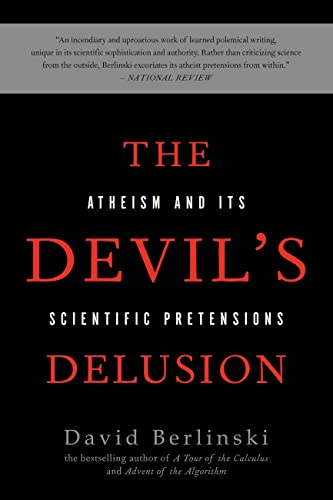
The Devil's Delusion by David Berlinski is a thought-provoking critique of atheism and a defense of theism. Berlinski argues that science does not disprove the existence of God and that the universe is more than just a product of random chance.
In The Devil's Delusion by David Berlinski, the author delves into the complex relationship between science and religion, challenging the notion that science has eliminated the need for a divine creator. Berlinski, a philosopher and mathematician, argues that science has its limitations and cannot fully account for the mysteries of existence.
The book begins with Berlinski's critique of the New Atheists, a group of prominent scientists and writers who argue that science has rendered religious belief obsolete. He criticizes their arguments, asserting that they rely on a narrow, dogmatic interpretation of science and that their conclusions are based more on ideology than on evidence.
Berlinski then moves on to examine some of the most profound questions in science and philosophy, such as the origin of the universe, the existence of consciousness, and the nature of morality. He argues that science has yet to provide satisfactory answers to these questions and that there are aspects of reality that may forever lie beyond the reach of scientific investigation.
The author also takes aim at the idea that the universe is a product of chance, arguing that the fine-tuning of physical constants necessary for life to exist suggests a purposeful design. He questions the prevailing scientific view that life arose purely through natural processes, suggesting that the complexity of living organisms points to an intelligent designer.
In the later parts of The Devil's Delusion, Berlinski explores the historical relationship between science and religion. He argues that many of the greatest scientists in history, including Isaac Newton and Albert Einstein, were deeply religious individuals who saw their work as a way of understanding God's creation. He also points out that many of the earliest scientific theories, such as the Big Bang, were developed by scientists with religious beliefs.
Throughout the book, Berlinski emphasizes the importance of humility in both science and religion. He argues that scientists should acknowledge the limits of their knowledge and be open to the possibility of a higher power, while religious believers should not reject scientific discoveries that challenge their beliefs.
In conclusion, The Devil's Delusion presents a thought-provoking critique of the New Atheists' position and a defense of the compatibility of science and religion. Berlinski does not argue for a return to a pre-scientific worldview, but rather for a more nuanced understanding of the relationship between science, faith, and the mysteries of existence.
He asserts that while science has provided us with valuable knowledge about the natural world, it cannot answer all of life's deepest questions. Ultimately, Berlinski suggests that both science and religion offer different, but equally valid, ways of understanding the world, and that a truly comprehensive worldview requires the integration of both perspectives.


The Devil's Delusion by David Berlinski challenges the assumptions of the "new atheists" and argues that science does not disprove the existence of God. With wit and insight, Berlinski examines the limitations of scientific reasoning and explores the philosophical and theological implications of modern scientific theories.
Individuals interested in exploring the intersection of science and religion
Readers who enjoy thought-provoking discussions about the nature of reality
Those seeking a critical analysis of atheism and its arguments against faith
It's highly addictive to get core insights on personally relevant topics without repetition or triviality. Added to that the apps ability to suggest kindred interests opens up a foundation of knowledge.
Great app. Good selection of book summaries you can read or listen to while commuting. Instead of scrolling through your social media news feed, this is a much better way to spend your spare time in my opinion.
Life changing. The concept of being able to grasp a book's main point in such a short time truly opens multiple opportunities to grow every area of your life at a faster rate.
Great app. Addicting. Perfect for wait times, morning coffee, evening before bed. Extremely well written, thorough, easy to use.
Try Blinkist to get the key ideas from 7,500+ bestselling nonfiction titles and podcasts. Listen or read in just 15 minutes.
Get started for freeBlink 3 of 8 - The 5 AM Club
by Robin Sharma