


Powerful ideas from top nonfiction
Try Blinkist to get the key ideas from 7,500+ bestselling nonfiction titles and podcasts. Listen or read in just 15 minutes.
Get started for free
Blink 3 of 8 - The 5 AM Club
by Robin Sharma
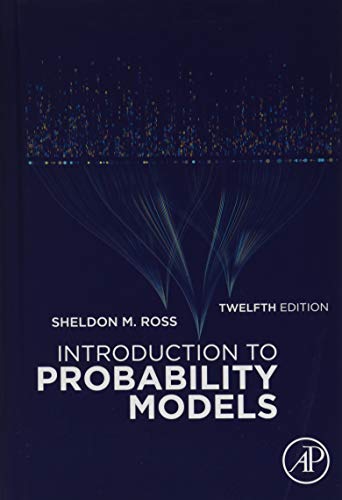
Introduction to Probability Models by Sheldon M. Ross is a comprehensive guide to the theory and applications of probability. It covers concepts such as random variables, Markov chains, and queueing theory, making it a valuable resource for students and professionals.
In Introduction to Probability Models by Sheldon M. Ross, we embark on a journey to understand the fundamental concepts of probability models. The book begins by introducing the basic principles of probability, including sample spaces, events, and probability laws. It then delves into the concept of random variables, their probability distributions, and their expected values and variances.
As we progress, the book introduces us to various probability models, starting with the Bernoulli process and its extensions, such as the binomial, geometric, and negative binomial models. We then explore the Poisson process, which is widely used to model the occurrence of rare events over time, and its applications in various fields, including telecommunications, biology, and finance.
Next, Introduction to Probability Models takes us into the world of Markov chains, a fundamental concept in probability theory. We learn about the properties of Markov chains, including their transition probabilities, classification, and long-term behavior. The book also discusses various applications of Markov chains, such as in modeling random walks, queueing systems, and reliability analysis.
Furthermore, the book explores more advanced topics related to Markov chains, including absorbing chains, birth-death processes, and continuous-time Markov chains. These topics are accompanied by real-world examples and exercises to help us understand the practical implications of these models.
Continuing our exploration, Introduction to Probability Models introduces us to continuous-time Markov chains, which are used to model systems that evolve in continuous time, such as inventory systems and chemical reaction networks. We learn about the Poisson process, which serves as the building block for continuous-time Markov chains, and its various applications.
The book then delves into queueing theory, a field that deals with the study of waiting lines and the systems that create them. We explore different types of queueing systems, including single-server and multi-server queues, and learn about performance measures such as waiting times, queue lengths, and system utilization.
As we near the end of our journey, Introduction to Probability Models introduces us to reliability theory, which focuses on the study of the lifetime and failure of systems. We learn about various reliability models, including the exponential and Weibull distributions, and explore concepts such as system reliability, availability, and maintainability.
Finally, the book concludes with a discussion on simulation, a powerful tool used to model and analyze complex systems. We learn about the Monte Carlo method, which uses random sampling to solve deterministic problems, and its applications in various fields, including finance, engineering, and operations research.
In conclusion, Introduction to Probability Models by Sheldon M. Ross provides a comprehensive and accessible introduction to the world of probability models. Through its clear explanations, numerous examples, and practical applications, the book equips us with the knowledge and tools to understand and analyze a wide range of real-world phenomena using probability models.


Introduction to Probability Models by Sheldon M. Ross provides a comprehensive introduction to the theory and application of probability models. It covers a wide range of topics including random variables, Markov chains, queuing theory, and simulation. With clear explanations and numerous examples, this book is a valuable resource for students and professionals in the fields of statistics, engineering, and operations research.
Introduction to Probability Models (2019) is a comprehensive book that explores the fascinating world of probability models and their applications. Here's why this book is worth reading:
It's highly addictive to get core insights on personally relevant topics without repetition or triviality. Added to that the apps ability to suggest kindred interests opens up a foundation of knowledge.
Great app. Good selection of book summaries you can read or listen to while commuting. Instead of scrolling through your social media news feed, this is a much better way to spend your spare time in my opinion.
Life changing. The concept of being able to grasp a book's main point in such a short time truly opens multiple opportunities to grow every area of your life at a faster rate.
Great app. Addicting. Perfect for wait times, morning coffee, evening before bed. Extremely well written, thorough, easy to use.
Try Blinkist to get the key ideas from 7,500+ bestselling nonfiction titles and podcasts. Listen or read in just 15 minutes.
Get started for freeBlink 3 of 8 - The 5 AM Club
by Robin Sharma
What is the main message of Introduction to Probability Models?
Gain an understanding of probability through real-world examples and mathematical models.
How long does it take to read Introduction to Probability Models?
The reading time for Introduction to Probability Models varies depending on the reader's speed, but it typically takes several hours. The Blinkist summary can be read in just 15 minutes.
Is Introduction to Probability Models a good book? Is it worth reading?
Introduction to Probability Models is an informative and valuable read, providing a solid foundation in probability theory.
Who is the author of Introduction to Probability Models?
The author of Introduction to Probability Models is Sheldon M. Ross.