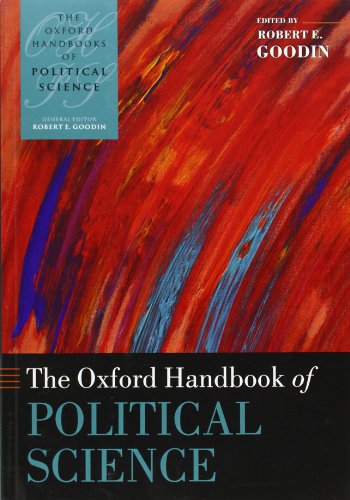
Better than a summary
The Oxford Handbook of Political Science summary
Robert E. Goodin
No credit card required · Cancel anytime
The Oxford Handbook of Political Science serves as a comprehensive guide to the field of political science, covering topics such as political theory, institutions, behavior, and more. It provides a valuable resource for students and scholars alike.
Topics
Table of Contents
- The Oxford Handbook of Political Science: summary of key ideas
- What is The Oxford Handbook of Political Science about?
- The Oxford Handbook of Political Science Review
- Who should read The Oxford Handbook of Political Science?
- About the author
- Book summaries like The Oxford Handbook of Political Science
- People also liked these summaries
- The Oxford Handbook of Political Science FAQs
The Oxford Handbook of Political Science
Summary of key ideas
Seeing The Broad Scope Of Political Science
In The Oxford Handbook of Political Science, edited by Robert E. Goodin and Hans-Dieter Klingemann, the authors meticulously curate the remarkable landscape of political science. They accomplish this by assembling a collection of essays from more than sixty leading scholars in the field, each offering their insights and perspectives across the broad spectrum of political science.
Starting with the core of political science, the book delves into multiple aspects - political theory, institutions, behavior, comparative politics, international relations, public policy, and more. The authors discuss topics such as democratic theory, the role of states and institutions, voting behavior, and the complex mechanism of global politics.
Exploring Key Subfields
In The Oxford Handbook of Political Science, various subfields are also deeply explored. These include political economy, public policy, and political methodology. Economy and policy are widely regarded as vital for understanding governments' practices, as they determine the ways in which resources are managed and public policies are formulated and executed. The application of methodological approaches also plays an important role, as it provides the tools and techniques with which political scientists analyze political phenomena.
Further, the authors discuss the role of law in politics, as well as contextual political analysis. Law is highlighted as an essential regulating factor in political behavior, while contextual political analysis investigates how these factors are constructed and affected by specific contexts. Given the diverse nature of politics, both these fields are critical in widening our understanding of political science.
Adopting a Comparative Perspective
Several chapters are dedicated to the concept of comparative politics, reflecting the growing acknowledgment that political events and behaviors unfold within specific historical, social, and cultural contexts. This section surveys countries worldwide, comparing political structures, processes and behavior among them. It also introduces the idea of comparative political experiment, utilizing controlled comparisons to understand key relationships between political institutions and governance.
Amidst the extraordinary array of topics discussed, the authors collectively strive to offer their perspectives and to challenge established assumptions. They emphasize the fluidity and dynamism of political science, valuing innovative theories, methodologies, and data resources.
Key Relationships and Global Issues
The handbook does not shy away from addressing the major political issues that plague our global society. They elaborate on the intricate linkages between national economic and political processes and the global system. By doing so, they outline the key relationships between the political and economic spheres.
Moreover, there is also emphasis placed on perennial problems, such as war, ethno-political conflicts, and systemic economic issues. Each of these demanding situations are presented through various theoretical, empirical, and historical lenses, aiming to offer a more nuanced understanding.
Looking To The Future
In conclusion, The Oxford Handbook of Political Science is an invitation to the rich and multifaceted landscape of political science, both past and present. The book places an emphasis on interdisciplinary approaches, embracing diverse methodologies, and reaching across traditional academic boundaries. The authors consistently emphasize that much remains to be explored, encouraging readers to engage with the evolving field and pointing to a hopeful future of deeper understanding of complex political phenomena.
More knowledge in less time

Read or listen
Get the key ideas from nonfiction bestsellers in minutes, not hours.

Find your next read
Get book lists curated by experts and personalized recommendations.

Shortcasts
We've teamed up with podcast creators to bring you key insights from podcasts.
What is The Oxford Handbook of Political Science about?
The Oxford Handbook of Political Science provides a comprehensive overview of the field, covering topics such as political theory, comparative politics, public policy, and international relations. Edited by Robert E. Goodin, this book brings together leading scholars to explore key issues and debates in political science, making it an essential resource for students and researchers.
The Oxford Handbook of Political Science Review
The Oxford Handbook of Political Science (2011) is a comprehensive collection of essays that offers valuable insights into the field of political science. Here's why this book is worth reading:
- Featuring expert contributors who delve into various aspects of political science, this book provides a diverse and well-rounded understanding of the subject.
- With its in-depth analysis of key concepts, theories, and methodologies, it serves as an excellent resource for both students and scholars in the field.
- By exploring a wide range of topics, from democracy and governance to international relations, this book captures the complexity of political science and keeps readers engaged throughout.
Who should read The Oxford Handbook of Political Science?
- Undergraduate and graduate students studying political science
- Academics and researchers seeking a comprehensive overview of the field
- Politically engaged individuals who want to deepen their understanding of political processes
Categories with The Oxford Handbook of Political Science
Book summaries like The Oxford Handbook of Political Science
 Where Good Ideas Come FromSteven JohnsonThe Natural History of Innovation4.1
 God is not greatChristopher HitchensHow Religion Poisons Everything3.9
 A Brief History of Time Stephen HawkingFrom the Big Bang to Black Holes4.4
 The Selfish GeneRichard DawkinsA landmark work in the field of biology and evolution4.4
 AntifragileNassim Nicholas TalebThings That Gain from Disorder4.5
 Physics of the futureMichio KakuHow Science Will Shape Human Destiny and Our Daily Lives by the Year 21004.1
 MusicophiliaOliver SacksTales of Music and the Brain, Revised and Expanded Edition4.3
 How Music Works David ByrneHow circumstance and creativity collide in tune4.4
 The Sports GeneDavid EpsteinInside the Science of Extraordinary Athletic Performance4.3
 On intelligence Jeff Hawkins, Sandra BlakesleeHow a New Understanding of the Brain Will Lead to the Creation of Truly Intelligent Machines3.9
 Nutrition and Physical DegenerationWeston Andrew PriceA Comparison of Primitive and Modern Diets and their Effects4.2
 GutGiulia EndersThe Inside Story of Our Body’s Most Underrated Organ4.3
 Bad ScienceBen GoldacreA behind-the-scenes look at the bogus science used to mislead us every day.4.4
 Moonwalking with EinsteinJoshua FoerThe Art and Science of Remembering Everything4.2
 Do No Harm Henry MarshStories of Life, Death, and Brain Surgery4.2
 Fluent ForeverGabriel WynerHow to Learn Any Language Fast and Never Forget It4.3
 Life at the Speed of Light J. Craig VenterFrom the Double Helix to the Dawn of Digital Life4.3
 The Language InstinctSteven PinkerHow the Mind Creates Language4.0
 A mind for numbersBarbara OakleyHow to Excel at Math and Science (Even If You Flunked Algebra)4.3
 The Structure of Scientific RevolutionsThomas S. KuhnA groundbreaking study in how science progresses4.3
 SmarterDan HurleyThe New Science of Building Brain Power3.6
 An Astronaut’s Guide to Life on EarthChris HadfieldWhat Going to Space Taught Me About Ingenuity, Determination, and Being Prepared for Anything3.9
 The Demon-Haunted WorldCarl SaganScience as a Candle in the Dark4.3
 Moore’s LawArnold Thackray, David Brock and Rachel JonesThe Life of Gordon Moore, Silicon Valley’s Quiet Revolutionary4.3
 Grain BrainDavid PerlmutterThe Surprising Truth about Wheat, Carbs, and Sugar4.3
 What If?Randall MunroeSerious Scientific Answers to Absurd Hypothetical Questions3.4
 On ImmunityEula BissAn Inoculation3.3
 Sonic BoomJoel Beckerman (Autor), Tyler GrayHow Sound Transforms the Way We Think, Feel, and Buy3.4
 Consider the ForkBee WilsonHow Technology Transforms the Way We Cook and Eat3.8
 Driven Paul Lawrence & Nitin NohriaHow Human Nature Shapes our Choices3.6
People ❤️ Blinkist
Become a member of our community of 44 million people

96k ratings

73k ratings
Sven O.
It's highly addictive to get core insights on personally relevant topics without repetition or triviality. Added to that the apps ability to suggest kindred interests opens up a foundation of knowledge.
Jonathan A.
Clearly communicates the value proposition of the most popular book summaries and offers a relatable, tangible template that I can use immediately.
Guillem B.
Life changing. The concept of being able to grasp a book's main point in such a short time truly opens multiple opportunities to grow every area of your life at a faster rate.
People also liked these summaries
 The Audacity of HopeBarack ObamaThoughts on Reclaiming the American Dream4.5
 The Road to SerfdomF.H. HayekTeaser: Van Hayek's classic text on Freedom4.4
 No LogoNaomi KleinTaking Aim at the Brand Bullies4.2
 Man, the State and WarKenneth N. WaltzA Theoretical Analysis4.4
 The Origin of WealthEric D. BeinhockerThe Radical Remaking of Economics and What It Means for Business And Society3.9
 The Communist ManifestoKarl Marx, Friedrich EngelsWorkers of the world unite!4.2
 The SleepwalkersChristopher ClarkHow Europe Went to War in 19144.5
 The PrinceNiccolò MachiavelliMachiavelli’s classic text on leadership and politics4.5
 Second Treatise of the GovernmentJohn LockeAn Essay Concerning the True Origin, Extent and End of Civil Government4.2
 ImmigrantsPhillippe LegrainYour Country Needs Them4.0
 The End of PowerMoisés NaímFrom Boardrooms to Battlefields and Churches to States, Why Being in Charge Isn’t What It Used To Be4.4
 Energy Myths and RealitiesVaclav SmilBringing Science to the Energy Policy Debate3.8
 The RepublicPlatoTEASER: One of the most important philosophical texts ever written4.5
 The Wealth of NationsAdam SmithThe most influential economic book of all time4.3
 Gang Leader For A DaySudhir VenkateshA Rogue Sociologist Crosses The Line3.8
 LeviathanThomas HobbesTeaser: Thomas Hobbes' classic4.5
 Guantánamo DiaryMohamedou Ould Slahi, edited by Larry SiemsGuantanamo from the Inside4.6
 The Innovator's PrescriptionClayton Christensen, Jerome H. Grossman and Jason D. HwangA Disruptive Solution for Health Care3.5
 Outsider in the White HouseBernie Sanders with Huck GutmanThe political autobiography of the insurgent presidential candidate4.3
 Engines of LibertyDavid ColeThe Power of Citizen Activists to Make Constitutional Law3.6
 You Can’t Read This BookNick CohenCensorship in an Age of Freedom3.9
 MeltdownThomas E. Woods, Jr.A Free-Market Look at Why the Stock Market Collapsed, the Economy Tanked, and Government Bailouts Will Make Things Worse3.9
 The WikiLeaks FilesJulian Assange (introduction)The World According to US Empire4.3
 The Making of Donald TrumpDavid Cay JohnstonHow Donald Trump rose to the pinnacle of power3.0
 Black FlagsJoby WarrickThe Rise of ISIS4.2
 Why The West Rules – For NowIan MorrisThe Patterns of History, and What They Reveal About the Future4.3
 The Gulag Archipelago 1918-1956Aleksandr SolzhenitsynAn Experiment in Literary Investigation4.6
 The Death of TruthMichiko KakutaniNotes on Falsehood in the Age of Trump3.5
 The Road to UnfreedomTimothy SnyderRussia, Europe, America4.2
 Liars, Leakers, and LiberalsJeanine PirroThe Case Against the Anti-Trump Conspiracy2.8
Trusted by the world's leading brands

Powerful ideas from top nonfiction
Try Blinkist to get the key ideas from 7,500+ bestselling nonfiction titles and podcasts. Listen or read in just 15 minutes.
Get started
Blink 3 of 8 - The 5 AM Club
by Robin Sharma
The Oxford Handbook of Political Science FAQs
What is the main message of The Oxford Handbook of Political Science?
The main message of The Oxford Handbook of Political Science is a comprehensive overview of the field of political science.
How long does it take to read The Oxford Handbook of Political Science?
The reading time for The Oxford Handbook of Political Science varies depending on the reader's speed. However, the Blinkist summary can be read in just 15 minutes.
Is The Oxford Handbook of Political Science a good book? Is it worth reading?
The Oxford Handbook of Political Science is an essential read for anyone interested in political science. It provides valuable insights and knowledge in a concise format.
Who is the author of The Oxford Handbook of Political Science?
The author of The Oxford Handbook of Political Science is Robert E. Goodin.