Better than a summary
Into Thin Air summary
No credit card required · Cancel anytime
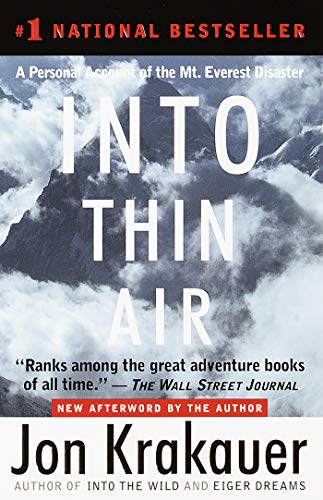
Into Thin Air is a gripping firsthand account by Jon Krakauer of the ill-fated 1996 Everest expedition. It provides a harrowing and detailed portrayal of the dangers and tragedies that can occur in the pursuit of climbing the world's highest peak.
Topics
Into Thin Air
Summary of key ideas
Surviving the Everest Disaster
In Into Thin Air by Jon Krakauer, we are taken on a journey to the top of the world, Mount Everest. Krakauer, a journalist and experienced climber, was assigned to cover the commercialization of Everest by joining an expedition led by Rob Hall. The book begins with the team's arrival at Base Camp, where Krakauer introduces us to the diverse group of climbers, each with their own motivations and fears.
As the team begins their ascent, Krakauer describes the harsh conditions and the physical and mental toll it takes on the climbers. Despite the challenges, they reach the summit, but their joy is short-lived as a sudden storm engulfs the mountain. The team is caught in the deadly blizzard, and the situation quickly turns into a fight for survival.
Tragic Losses and Survivor's Guilt
During the descent, the climbers face a series of calamities. Krakauer, suffering from exhaustion and oxygen deprivation, barely makes it back to camp. However, many others, including Rob Hall, perish in the storm. Krakauer's account of the disaster is raw and unflinching, and he doesn't shy away from sharing his own feelings of guilt and responsibility for the tragedy.
Back in the safety of civilization, Krakauer struggles to come to terms with the disaster. He grapples with the question of whether the commercialization of Everest and the desire to conquer the mountain at any cost led to the deaths of his fellow climbers. Krakauer's internal turmoil is palpable, and his candid narrative allows us to understand the complex emotions that arise from surviving such a harrowing experience.
Controversy and Aftermath
As Krakauer's story gains attention, it sparks a heated debate within the mountaineering community. His portrayal of the events differs from other survivors' accounts, leading to conflicting perspectives on what truly happened on the mountain. Krakauer's struggle with survivor's guilt is further compounded by the public scrutiny and criticism he faces.
Despite the controversy, Into Thin Air serves as a cautionary tale about the dangers of commercialized mountaineering and the hubris of attempting to conquer nature. Krakauer's narrative sheds light on the ethical dilemmas faced by guides and climbers, and the fine line between ambition and recklessness in extreme environments.
Reflection and Closure
In the final chapters of the book, Krakauer reflects on the impact of the Everest disaster on his life. He acknowledges that the experience has changed him irrevocably, and he grapples with the question of whether the risks he took were worth the tragic outcome. Despite the trauma, Krakauer's love for the mountains endures, albeit with a newfound respect for their power and unpredictability.
In conclusion, Into Thin Air is a gripping and introspective account of one of the deadliest Everest expeditions in history. Krakauer's narrative is a powerful exploration of human ambition, the fragility of life, and the enduring allure of the world's highest peak. It's a story that stays with you long after you've turned the final page.
More knowledge in less time

Read or listen
Get the key ideas from nonfiction bestsellers in minutes, not hours.

Find your next read
Get book lists curated by experts and personalized recommendations.

Shortcasts
We've teamed up with podcast creators to bring you key insights from podcasts.
What is Into Thin Air about?
Into Thin Air (1997) by Jon Krakauer is a gripping firsthand account of a disastrous expedition up Mount Everest. Krakauer, a journalist and mountaineer, takes readers on a harrowing journey to the summit, exploring the dangers and consequences of extreme altitude climbing. This powerful tale delves into themes of survival, accountability, and the indomitable human spirit. It will leave you breathless and deeply reflective.
Into Thin Air Review
Into Thin Air (1997) is a gripping account of the deadly 1996 Mount Everest disaster and a testament to the indomitable human spirit. Here's why this book is worth reading:
- The book provides a harrowing firsthand experience of the dangers and challenges faced by climbers on Mount Everest, immersing readers in the intense physical and emotional journey.
- Through vivid descriptions and personal narratives, the book paints a vivid picture of the breathtaking beauty and unforgiving brutality of the world's highest peak.
- With its unflinching honesty and thought-provoking reflections, the book explores the complex dynamics of teamwork, leadership, and the pursuit of personal goals in extreme circumstances.
Who should read Into Thin Air?
- Readers with an interest in adventure and extreme sports
- Individuals who enjoy gripping, real-life survival stories
- Those who want to gain a deeper understanding of the challenges and risks associated with high-altitude mountaineering
Categories with Into Thin Air
Book summaries like Into Thin Air
 I Am MalalaMalala YousafzaiThe Girl Who Stood Up for Education and Was Shot by the Taliban 4.5
 The MonopolistsMary PilonObsession, Fury and the Scandal Behind the World's Favorite Board Game4.0
 SapiensYuval Noah HarariA Brief History of Humankind4.3
 Doubt: A HistoryJennifer Michael HechtThe Great Doubters and Their Legacy of Innovation from Socrates and Jesus to Thomas Jefferson and Emily Dickinson3.6
 The Better Angels of Our Nature Steven PinkerWhy Violence has Declined4.5
 Bourbon EmpireReid MitenbulerThe Past and Future of America's Whiskey4.4
 The Story of SushiTrevor CorsonAn Unlikely Saga of Raw Fish and Rice4.0
 Genghis Khan and the Making of the Modern WorldJack WeatherfordThe fascinating story behind the Mongol Empire4.3
 Black FlagsJoby WarrickThe Rise of ISIS4.2
 Ta-Ra-Ra-Boom-De-AySimon Napier-BellThe (Dodgy) Business of Popular Music4.0
 How To Be Like WaltPat WilliamsCapturing the Disney Magic Every Day of Your Life4.1
 The Geography of BlissEric WeinerOne Grump’s Search for the Happiest Places in the World4.3
 A People’s History of the United StatesHoward ZinnA brilliant and moving history of the American people3.9
 CannibalismBill SchuttA Perfectly Natural History 3.8
 Women and PowerMary BeardA Manifesto4.1
 21 Lessons for the 21st CenturyYuval Noah HarariTeaser: Future proof yourself against the 21st Century4.4
 A History of GodKaren ArmstrongThe 4,000-Year Quest of Judaism, Christianity and Islam4.2
 CivilizationsMary BeardHow Do We Look / The Eye of Faith4.1
 The Spy and the TraitorBen MacintyreThe Greatest Espionage Story of the Cold War4.6
 The Origins of TotalitarianismHannah ArendtHannah Arendt's landmark work about Europe's anti-Semitic and imperialist roots4.6
 DreamlandSam QuinonesThe True Tale of America’s Opiate Epidemic4.5
 The Happiness FantasyCarl CederströmTeaser: A history of happiness3.8
 Why The West Rules – For NowIan MorrisThe Patterns of History, and What They Reveal About the Future4.3
 The New Silk RoadsPeter FrankopanThe Present and Future of the World3.9
 The Golden ThreadKassia St ClairHow Fabric Changed History4.1
 The Square and the TowerNiall FergusonNetworks and Power, from the Freemasons to Facebook4.4
 IslamKaren ArmstrongA Short History4.2
 Revolutionary IranMichael AxworthyA History of the Islamic Republic4.0
 China in Ten WordsYu HuaTeaser: The ten key concePDs underlying China’s transformation4.1
 The Congo from Leopold to KabilaGeorges Nzongola-NtalajaA People's History4.3
People ❤️ Blinkist
Become a member of our community of 44 million people

96k ratings

73k ratings
Jonathan A.
Clearly communicates the value proposition of the most popular book summaries and offers a relatable, tangible template that I can use immediately.
Renee D.
I'm absolutely thrilled that Blinkist now offers infographics! I can't get enough of them—they're such a fun and effective way to grasp and remember key points.
Guillem B.
Life changing. The concept of being able to grasp a book's main point in such a short time truly opens multiple opportunities to grow every area of your life at a faster rate.
People also liked these summaries
 A Canticle for LeibowitzWalter M. Miller
 The Boy in the Striped PajamasJohn BoyneTeaser: Heartbreaking Truths Unfold in a Tale of Friendship and Innocence4.9
 Little House in the Big WoodsLaura Ingalls Wilder
 Wide Sargasso SeaJean Rhys, Judith L. Raiskin
 Just After SunsetStephen King
 WhereaboutsJhumpa Lahiri
 Hearts in DarknessLaura Kaye
 Every Heart a DoorwaySeanan McGuire
 The Curious Case of Benjamin ButtonF. Scott Fitzgerald, Nunzio DeFilippis
 Side JobsJim Butcher
 Brokeback MountainAnnie Proulx
 A Single ManChristopher Isherwood
 And Every Morning the Way Home Gets Longer and LongerFredrik Backman, Alice Menzies
 Burning ChromeWilliam Gibson
 Hearts in AtlantisStephen King
 Bonjour TristesseFrancoise Sagan
 Chronicle of a Death ForetoldGabriel García Márquez, Gregory Rabassa
 For Whom the Bell TollsErnest Hemingway
 The Last QuestionIsaac Asimov
 The 5th WaveRick Yancey
 The Killer AngelsMichael Shaara
 The Martian ChroniclesRay Bradbury
 Cloud AtlasDavid Mitchell
 The Forever WarJoe Haldeman
 I, RobotIsaac Asimov
 Kill SwitchPenelope Douglas
 The Alice NetworkKate Quinn
 Number the StarsLois Lowry
 The SympathizerViet Thanh Nguyen
 City of ThievesDavid Benioff
Trusted by the world's leading brands

Powerful ideas from top nonfiction
Try Blinkist to get the key ideas from 7,500+ bestselling nonfiction titles and podcasts. Listen or read in just 15 minutes.
Get started
Blink 3 of 8 - The 5 AM Club
by Robin Sharma
Into Thin Air FAQs
What is the main message of Into Thin Air?
The main message of Into Thin Air is the devastating consequences of high-altitude mountaineering.
How long does it take to read Into Thin Air?
The reading time for Into Thin Air varies depending on the reader's speed, but it typically takes several hours. However, the Blinkist summary can be read in just 15 minutes.
Is Into Thin Air a good book? Is it worth reading?
Into Thin Air is an gripping account of a tragic Everest expedition. It offers important insights into the dangers and complexities of climbing the world's highest mountain.
Who is the author of Into Thin Air?
Jon Krakauer is the author of Into Thin Air.