Better than a summary
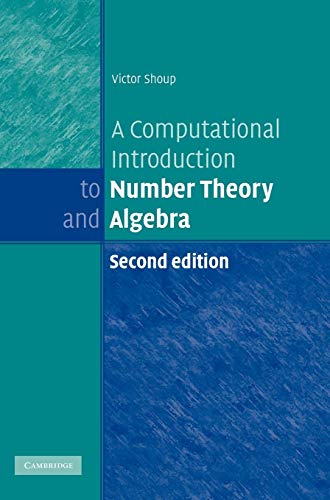
A Computational Introduction to Number Theory and Algebra summary
Victor Shoup
No credit card required · Cancel anytime
A Computational Introduction to Number Theory and Algebra by Victor Shoup is a comprehensive guide that explores the fundamental concepts of number theory and algebra through a computational lens, making it an invaluable resource for both students and professionals in the field.
Topics
Table of Contents
- A Computational Introduction to Number Theory and Algebra: summary of key ideas
- What is A Computational Introduction to Number Theory and Algebra about?
- A Computational Introduction to Number Theory and Algebra Review
- Who should read A Computational Introduction to Number Theory and Algebra?
- About the author
- Book summaries like A Computational Introduction to Number Theory and Algebra
- People also liked these summaries
- A Computational Introduction to Number Theory and Algebra FAQs
A Computational Introduction to Number Theory and Algebra
Summary of key ideas
The Foundation of Number Theory
In A Computational Introduction to Number Theory and Algebra by Victor Shoup, we embark on a journey to understand the foundational concepts of number theory and algebra from a computational perspective. The book begins with a comprehensive introduction to the fundamental concepts of number theory, such as divisibility, prime numbers, and congruences. Shoup expertly intertwines the theoretical aspects with their computational applications, emphasizing the importance of algorithms in number theory.
The book introduces the reader to the Euclidean algorithm, which is used to compute the greatest common divisor of two numbers. Shoup then delves into modular arithmetic and its applications, including cryptographic algorithms such as RSA, which are based on the difficulty of factoring large composite numbers.
Algorithms and Prime Numbers
Shoup continues to explore the computational aspects of number theory by discussing algorithms for primality testing and factorization. He explains the importance of prime numbers in cryptography and demonstrates how efficient algorithms for prime number generation are crucial in the design of secure cryptographic systems.
After establishing the computational foundations of number theory, Shoup transitions to the study of algebraic structures. He introduces groups, rings, and fields, emphasizing their significance in modern cryptography and error-correcting codes. The author elucidates the computational aspects of these algebraic structures, such as the computation of modular inverses and the use of finite fields in cryptographic systems.
Polynomials and Error-Correcting Codes
Next, Shoup delves into the realm of polynomials, discussing their properties and algorithms for polynomial arithmetic. He then introduces the concept of error-correcting codes, explaining how polynomials and finite fields are used to design efficient error-correcting codes. The author presents numerous examples to illustrate the computational techniques used in error detection and correction.
Throughout the book, Shoup emphasizes the importance of computational techniques in the study of number theory and algebra. He provides numerous exercises and algorithmic problems to reinforce the concepts discussed and to encourage the reader to explore the computational aspects of the subject further.
Advanced Topics and Concluding Remarks
In the latter part of the book, Shoup explores advanced topics such as elliptic curve cryptography, a modern and powerful cryptographic technique based on elliptic curves over finite fields. He provides a comprehensive introduction to the underlying mathematics and the computational aspects of elliptic curve cryptography.
In conclusion, A Computational Introduction to Number Theory and Algebra by Victor Shoup offers a unique blend of theoretical insights and practical applications in number theory and algebra. The book is an ideal resource for students and professionals interested in understanding the computational foundations of these mathematical disciplines and their crucial role in modern cryptography, coding theory, and computer science.
More knowledge in less time

Read or listen
Get the key ideas from nonfiction bestsellers in minutes, not hours.

Find your next read
Get book lists curated by experts and personalized recommendations.

Shortcasts
We've teamed up with podcast creators to bring you key insights from podcasts.
What is A Computational Introduction to Number Theory and Algebra about?
A Computational Introduction to Number Theory and Algebra by Victor Shoup provides a unique approach to learning these mathematical concepts. By integrating computational methods and algorithms, the book offers a practical and engaging way to explore number theory and algebra. It is suitable for students and professionals in mathematics, computer science, and related fields.
A Computational Introduction to Number Theory and Algebra Review
- Explains complex theories in clear and accessible language, making it suitable for both beginners and experts in the field.
- Provides numerous practical examples and exercises to reinforce learning and application of the theories discussed.
- Keeps readers engaged with its problem-solving approach, ensuring the content remains dynamic and far from dull.
Who should read A Computational Introduction to Number Theory and Algebra?
Students or professionals in computer science who want to deepen their understanding of number theory and algebra
Individuals interested in cryptography, data security, and encryption techniques
Mathematics enthusiasts looking for a practical and computational approach to number theory and algebra
Categories with A Computational Introduction to Number Theory and Algebra
Book summaries like A Computational Introduction to Number Theory and Algebra
 Where Good Ideas Come FromSteven JohnsonThe Natural History of Innovation4.1
 God is not greatChristopher HitchensHow Religion Poisons Everything3.9
 A Brief History of Time Stephen HawkingFrom the Big Bang to Black Holes4.4
 The Selfish GeneRichard DawkinsA landmark work in the field of biology and evolution4.4
 AntifragileNassim Nicholas TalebThings That Gain from Disorder4.5
 Physics of the futureMichio KakuHow Science Will Shape Human Destiny and Our Daily Lives by the Year 21004.1
 MusicophiliaOliver SacksTales of Music and the Brain, Revised and Expanded Edition4.3
 How Music Works David ByrneHow circumstance and creativity collide in tune4.4
 The Sports GeneDavid EpsteinInside the Science of Extraordinary Athletic Performance4.3
 On intelligence Jeff Hawkins, Sandra BlakesleeHow a New Understanding of the Brain Will Lead to the Creation of Truly Intelligent Machines3.9
 Nutrition and Physical DegenerationWeston Andrew PriceA Comparison of Primitive and Modern Diets and their Effects4.2
 GutGiulia EndersThe Inside Story of Our Body’s Most Underrated Organ4.3
 Bad ScienceBen GoldacreA behind-the-scenes look at the bogus science used to mislead us every day.4.4
 Moonwalking with EinsteinJoshua FoerThe Art and Science of Remembering Everything4.2
 Do No Harm Henry MarshStories of Life, Death, and Brain Surgery4.2
People ❤️ Blinkist
Become a member of our community of 44 million people

96k ratings

73k ratings
Jonathan A.
Clearly communicates the value proposition of the most popular book summaries and offers a relatable, tangible template that I can use immediately.
Thi Viet Quynh N.
Great app. Good selection of book summaries you can read or listen to while commuting. Instead of scrolling through your social media news feed, this is a much better way to spend your spare time in my opinion.
Sven O.
It's highly addictive to get core insights on personally relevant topics without repetition or triviality. Added to that the apps ability to suggest kindred interests opens up a foundation of knowledge.
People also liked these summaries
 Fluent ForeverGabriel WynerHow to Learn Any Language Fast and Never Forget It4.3
 Life at the Speed of Light J. Craig VenterFrom the Double Helix to the Dawn of Digital Life4.3
 The Language InstinctSteven PinkerHow the Mind Creates Language4.0
 A mind for numbersBarbara OakleyHow to Excel at Math and Science (Even If You Flunked Algebra)4.3
 The Structure of Scientific RevolutionsThomas S. KuhnA groundbreaking study in how science progresses4.3
 SmarterDan HurleyThe New Science of Building Brain Power3.6
 An Astronaut’s Guide to Life on EarthChris HadfieldWhat Going to Space Taught Me About Ingenuity, Determination, and Being Prepared for Anything3.9
 The Demon-Haunted WorldCarl SaganScience as a Candle in the Dark4.3
 Moore’s LawArnold Thackray, David Brock and Rachel JonesThe Life of Gordon Moore, Silicon Valley’s Quiet Revolutionary4.3
 Grain BrainDavid PerlmutterThe Surprising Truth about Wheat, Carbs, and Sugar4.3
 What If?Randall MunroeSerious Scientific Answers to Absurd Hypothetical Questions3.4
 On ImmunityEula BissAn Inoculation3.3
 Sonic BoomJoel Beckerman (Autor), Tyler GrayHow Sound Transforms the Way We Think, Feel, and Buy3.4
 Consider the ForkBee WilsonHow Technology Transforms the Way We Cook and Eat3.8
 Driven Paul Lawrence & Nitin NohriaHow Human Nature Shapes our Choices3.6
Trusted by the world's leading brands

Powerful ideas from top nonfiction
Try Blinkist to get the key ideas from 7,500+ bestselling nonfiction titles and podcasts. Listen or read in just 15 minutes.
Get started
Blink 3 of 8 - The 5 AM Club
by Robin Sharma