Better than a summary
The Fabric of the Cosmos summary
No credit card required · Cancel anytime
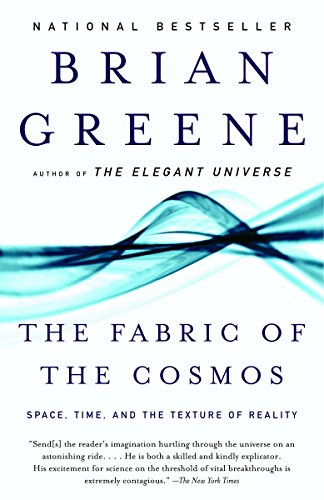
The Fabric of the Cosmos by Brian Greene explores the mind-bending theories of space, time, and the nature of reality. It takes readers on a captivating journey through cutting-edge physics, offering a deeper understanding of the universe.
The Fabric of the Cosmos
Summary of key ideas
Exploring the Mysteries of Space and Time
In The Fabric of the Cosmos, Brian Greene takes us on a journey through the fundamental concepts of space and time. He begins by exploring the nature of reality, questioning whether the universe is a fixed entity or a dynamic, ever-changing system. Greene introduces us to the concept of spacetime, a four-dimensional framework that combines the three dimensions of space with the dimension of time, as proposed by Albert Einstein's theory of general relativity.
Greene then delves into the nature of space itself, discussing the possibility of extra dimensions beyond the familiar three spatial dimensions. He introduces the concept of string theory, which suggests that the fundamental building blocks of the universe are not particles, but tiny, vibrating strings. These strings exist in a space with more than three dimensions, and their vibrations give rise to the particles and forces we observe in our three-dimensional world.
Time's Arrow and Quantum Uncertainty
Continuing his exploration of the fabric of the cosmos, Greene tackles the enigmatic nature of time. He discusses the concept of time's arrow, the idea that time has a definite direction, always moving from the past to the future. He explains how this apparent asymmetry of time is related to the increase of entropy, or disorder, in the universe, as described by the second law of thermodynamics.
Greene then introduces us to the strange world of quantum mechanics, where particles can exist in multiple states simultaneously and their behavior is governed by probability. He discusses the famous thought experiment of Schrödinger's cat, which illustrates the bizarre concept of quantum superposition, where a particle can exist in two contradictory states at once. Greene also explores the phenomenon of quantum entanglement, where the properties of particles become interconnected in such a way that the state of one particle instantaneously influences the state of another, regardless of the distance between them.
The Expanding Universe and the Big Bang
Shifting our focus to the large-scale structure of the universe, Greene discusses the concept of cosmic inflation, a period of extremely rapid expansion that occurred in the early universe. He explains how this inflationary phase can account for the uniformity and flatness of the universe, as well as the origin of the cosmic microwave background radiation, a remnant of the Big Bang.
Greene then takes us back to the moment of the Big Bang itself, discussing the singularity, a point of infinite density and temperature from which the universe is thought to have originated. He explains how our current understanding of physics breaks down at this point, and how a complete theory of quantum gravity is needed to describe the universe at such extreme conditions.
Parallel Universes and the Multiverse
In the final part of The Fabric of the Cosmos, Greene explores some of the most mind-bending implications of modern physics. He discusses the concept of parallel universes, where every possible outcome of a quantum event actually occurs in a separate universe. This idea, known as the multiverse, arises from certain interpretations of quantum mechanics and has profound implications for our understanding of reality.
Greene concludes by emphasizing the importance of continuing to explore and question the nature of the cosmos. He acknowledges that many of the concepts he has discussed, such as extra dimensions, string theory, and the multiverse, remain speculative and unproven. However, he argues that these ideas are essential for pushing the boundaries of our understanding and inspiring new avenues of research in theoretical physics.
More knowledge in less time

Read or listen
Get the key ideas from nonfiction bestsellers in minutes, not hours.

Find your next read
Get book lists curated by experts and personalized recommendations.

Shortcasts
We've teamed up with podcast creators to bring you key insights from podcasts.
What is The Fabric of the Cosmos about?
The Fabric of the Cosmos by Brian Greene takes readers on a mind-bending journey through space, time, and the nature of reality. With engaging storytelling and clear explanations, Greene delves into cutting-edge theories in physics and cosmology, offering a new perspective on the universe and our place within it. Whether you're a science enthusiast or a casual reader, this book will expand your understanding of the fundamental laws that govern the cosmos.
The Fabric of the Cosmos Review
The Fabric of the Cosmos (2004) by Brian Greene explores the deepest mysteries of the universe and why it matters. Here's why this book is worth reading:
- By delving into topics such as quantum mechanics and string theory, this book offers a fascinating journey that challenges our understanding of reality.
- Combining scientific research and thought experiments, it presents complex concepts in an accessible way, inviting readers to ponder the nature of existence.
- With its engaging storytelling and mind-bending ideas, this book ensures that readers are never bored, constantly pushing them to question what they think they know.
Who should read The Fabric of the Cosmos?
- Readers who are curious about the nature of reality and the universe
- Those with a fascination for physics and the latest scientific discoveries
- Individuals who enjoy mind-expanding and thought-provoking books
Categories with The Fabric of the Cosmos
Book summaries like The Fabric of the Cosmos
 Where Good Ideas Come FromSteven JohnsonThe Natural History of Innovation4.1
 God is not greatChristopher HitchensHow Religion Poisons Everything3.9
 A Brief History of Time Stephen HawkingFrom the Big Bang to Black Holes4.4
 The Selfish GeneRichard DawkinsA landmark work in the field of biology and evolution4.4
 AntifragileNassim Nicholas TalebThings That Gain from Disorder4.5
 Physics of the futureMichio KakuHow Science Will Shape Human Destiny and Our Daily Lives by the Year 21004.1
 MusicophiliaOliver SacksTales of Music and the Brain, Revised and Expanded Edition4.3
 How Music Works David ByrneHow circumstance and creativity collide in tune4.4
 The Sports GeneDavid EpsteinInside the Science of Extraordinary Athletic Performance4.3
 On intelligence Jeff Hawkins, Sandra BlakesleeHow a New Understanding of the Brain Will Lead to the Creation of Truly Intelligent Machines3.9
 Nutrition and Physical DegenerationWeston Andrew PriceA Comparison of Primitive and Modern Diets and their Effects4.2
 GutGiulia EndersThe Inside Story of Our Body’s Most Underrated Organ4.3
 Bad ScienceBen GoldacreA behind-the-scenes look at the bogus science used to mislead us every day.4.4
 Moonwalking with EinsteinJoshua FoerThe Art and Science of Remembering Everything4.2
 Do No Harm Henry MarshStories of Life, Death, and Brain Surgery4.2
People ❤️ Blinkist
Become a member of our community of 44 million people

96k ratings

73k ratings
Sven O.
It's highly addictive to get core insights on personally relevant topics without repetition or triviality. Added to that the apps ability to suggest kindred interests opens up a foundation of knowledge.
Renee D.
I'm absolutely thrilled that Blinkist now offers infographics! I can't get enough of them—they're such a fun and effective way to grasp and remember key points.
Jonathan A.
Clearly communicates the value proposition of the most popular book summaries and offers a relatable, tangible template that I can use immediately.
People also liked these summaries
 Fluent ForeverGabriel WynerHow to Learn Any Language Fast and Never Forget It4.3
 Life at the Speed of Light J. Craig VenterFrom the Double Helix to the Dawn of Digital Life4.3
 The Language InstinctSteven PinkerHow the Mind Creates Language4.0
 A mind for numbersBarbara OakleyHow to Excel at Math and Science (Even If You Flunked Algebra)4.3
 The Structure of Scientific RevolutionsThomas S. KuhnA groundbreaking study in how science progresses4.3
 SmarterDan HurleyThe New Science of Building Brain Power3.6
 An Astronaut’s Guide to Life on EarthChris HadfieldWhat Going to Space Taught Me About Ingenuity, Determination, and Being Prepared for Anything3.9
 The Demon-Haunted WorldCarl SaganScience as a Candle in the Dark4.3
 Moore’s LawArnold Thackray, David Brock and Rachel JonesThe Life of Gordon Moore, Silicon Valley’s Quiet Revolutionary4.3
 Grain BrainDavid PerlmutterThe Surprising Truth about Wheat, Carbs, and Sugar4.3
 What If?Randall MunroeSerious Scientific Answers to Absurd Hypothetical Questions3.4
 On ImmunityEula BissAn Inoculation3.3
 Sonic BoomJoel Beckerman (Autor), Tyler GrayHow Sound Transforms the Way We Think, Feel, and Buy3.4
 Consider the ForkBee WilsonHow Technology Transforms the Way We Cook and Eat3.8
 Driven Paul Lawrence & Nitin NohriaHow Human Nature Shapes our Choices3.6
Trusted by the world's leading brands

Powerful ideas from top nonfiction
Try Blinkist to get the key ideas from 7,500+ bestselling nonfiction titles and podcasts. Listen or read in just 15 minutes.
Get started
Blink 3 of 8 - The 5 AM Club
by Robin Sharma
The Fabric of the Cosmos FAQs
What is the main message of The Fabric of the Cosmos?
The main message of The Fabric of the Cosmos is that the universe is a complex and interconnected web of spacetime, and our understanding of it is continually evolving.
How long does it take to read The Fabric of the Cosmos?
The reading time for The Fabric of the Cosmos varies depending on the reader's speed. However, the Blinkist summary can be read in just 15 minutes.
Is The Fabric of the Cosmos a good book? Is it worth reading?
The Fabric of the Cosmos is a fascinating exploration of the universe that's definitely worth reading. It offers valuable insights and expands our understanding of the cosmos.
Who is the author of The Fabric of the Cosmos?
The author of The Fabric of the Cosmos is Brian Greene.