Better than a summary
The Ghost Map summary
No credit card required · Cancel anytime
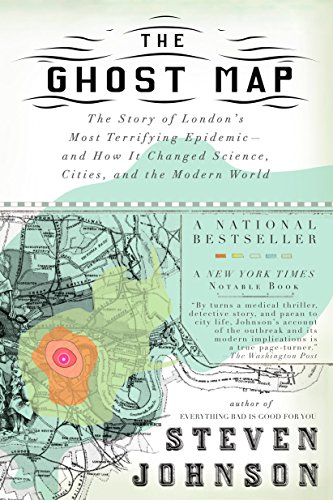
The Ghost Map by Steven Johnson is a gripping historical account of the 1854 London cholera epidemic. It follows Dr. John Snow and Reverend Henry Whitehead as they uncover the source of the outbreak, revolutionizing our understanding of public health.
Topics
The Ghost Map
Summary of key ideas
The Cholera Outbreak in London
In The Ghost Map by Steven Johnson, we are transported to London in 1854, a city grappling with a deadly cholera outbreak. The disease, which causes severe diarrhea and dehydration, is spreading rapidly, and the medical community is at a loss to explain its cause or find a cure. The prevailing theory at the time is that cholera is transmitted through miasma, or foul air, and this belief has led to misguided public health policies.
Johnson introduces us to Dr. John Snow, a pioneering anesthetist who suspects that cholera is not airborne but waterborne. He begins mapping the locations of cholera cases in Soho, a particularly hard-hit neighborhood, and discovers a cluster of cases around a public water pump on Broad Street. Snow's findings challenge the miasma theory and suggest that contaminated water is the source of the outbreak.
The Birth of Epidemiology
As Snow continues his investigation, we are introduced to Reverend Henry Whitehead, a local clergyman. Initially skeptical of Snow's theory, Whitehead becomes convinced of its validity after conducting his own interviews with the affected families. The collaboration between the scientifically trained Snow and the community-connected Whitehead is a testament to the power of interdisciplinary approaches in solving complex problems.
Together, Snow and Whitehead's work marks the birth of modern epidemiology. They identify the contaminated Broad Street pump as the source of the outbreak and convince local authorities to remove its handle, effectively halting the spread of cholera in the area. Their efforts provide compelling evidence for the waterborne transmission of the disease and lay the groundwork for future public health interventions.
Urbanization and Public Health
Johnson uses the Soho cholera outbreak as a lens to explore broader themes of urbanization and public health. London, like many other cities during the Industrial Revolution, was experiencing rapid population growth and inadequate infrastructure. The lack of proper sanitation and clean water made urban dwellers particularly vulnerable to infectious diseases like cholera.
However, the Soho outbreak also serves as a turning point. Snow and Whitehead's investigation prompts a reevaluation of public health policies, leading to improvements in urban sanitation and the establishment of water filtration systems. Their work demonstrates the potential for scientific inquiry to drive positive social change and highlights the importance of evidence-based decision-making in public health.
Lessons for the Present
In the final sections of The Ghost Map, Johnson draws parallels between the 1854 cholera outbreak and contemporary public health challenges. He emphasizes the ongoing relevance of Snow and Whitehead's work, particularly in the context of infectious disease control and urban planning. The book serves as a reminder of the enduring importance of understanding disease transmission and the critical role of public health infrastructure in preventing outbreaks.
In conclusion, The Ghost Map is a compelling narrative that weaves together history, science, and social commentary. Through the lens of a single cholera outbreak, Johnson illuminates the broader impact of urbanization on public health and the transformative potential of scientific inquiry. The book leaves us with a deeper appreciation for the pioneers of epidemiology and their enduring legacy in shaping our understanding of disease.
More knowledge in less time

Read or listen
Get the key ideas from nonfiction bestsellers in minutes, not hours.

Find your next read
Get book lists curated by experts and personalized recommendations.

Shortcasts
We've teamed up with podcast creators to bring you key insights from podcasts.
What is The Ghost Map about?
The Ghost Map by Steven Johnson examines the 1854 cholera outbreak in London and the investigation that led to a groundbreaking discovery in the field of public health. With meticulous research and compelling storytelling, Johnson uncovers the connection between the spread of the disease and the city's water source, ultimately changing the way we understand and combat infectious diseases. A must-read for anyone interested in the intersection of science, history, and urban development.
The Ghost Map Review
The Ghost Map (2006) is a fascinating exploration of the 1854 cholera outbreak in London and the groundbreaking map that helped solve the mystery. Here's why this book is worth reading:
- Offering a blend of history and science, it sheds light on the development of modern epidemiology and the power of data analysis.
- By delving into the lives of the individuals involved, the book brings the story to life and makes the reader invested in uncovering the truth behind the epidemic.
- With its detailed research and thorough examination of the social and political factors impacting the outbreak, it keeps readers engaged throughout.
Who should read The Ghost Map?
- Readers who are interested in the history of infectious diseases
- Those who enjoy narrative non-fiction and stories of scientific discovery
- Individuals who want to understand the impact of urbanization on public health
Categories with The Ghost Map
Book summaries like The Ghost Map
 I Am MalalaMalala YousafzaiThe Girl Who Stood Up for Education and Was Shot by the Taliban 4.5
 The MonopolistsMary PilonObsession, Fury and the Scandal Behind the World's Favorite Board Game4.0
 SapiensYuval Noah HarariA Brief History of Humankind4.3
 Doubt: A HistoryJennifer Michael HechtThe Great Doubters and Their Legacy of Innovation from Socrates and Jesus to Thomas Jefferson and Emily Dickinson3.6
 The Better Angels of Our Nature Steven PinkerWhy Violence has Declined4.5
 Bourbon EmpireReid MitenbulerThe Past and Future of America's Whiskey4.4
 The Story of SushiTrevor CorsonAn Unlikely Saga of Raw Fish and Rice4.0
 Genghis Khan and the Making of the Modern WorldJack WeatherfordThe fascinating story behind the Mongol Empire4.3
 Black FlagsJoby WarrickThe Rise of ISIS4.2
 Ta-Ra-Ra-Boom-De-AySimon Napier-BellThe (Dodgy) Business of Popular Music4.0
 How To Be Like WaltPat WilliamsCapturing the Disney Magic Every Day of Your Life4.1
 The Geography of BlissEric WeinerOne Grump’s Search for the Happiest Places in the World4.3
 A People’s History of the United StatesHoward ZinnA brilliant and moving history of the American people3.9
 CannibalismBill SchuttA Perfectly Natural History 3.8
 Women and PowerMary BeardA Manifesto4.1
People ❤️ Blinkist
Become a member of our community of 44 million people

96k ratings

73k ratings
Jonathan A.
Clearly communicates the value proposition of the most popular book summaries and offers a relatable, tangible template that I can use immediately.
Laura H.
When I saw Blinkist had produced an infographic style Blink for the Rich Dad, Poor Dad book, it was a good reminder of the concepts I loved.
Thi Viet Quynh N.
Great app. Good selection of book summaries you can read or listen to while commuting. Instead of scrolling through your social media news feed, this is a much better way to spend your spare time in my opinion.
People also liked these summaries
 21 Lessons for the 21st CenturyYuval Noah HarariTeaser: Future proof yourself against the 21st Century4.4
 A History of GodKaren ArmstrongThe 4,000-Year Quest of Judaism, Christianity and Islam4.2
 CivilizationsMary BeardHow Do We Look / The Eye of Faith4.1
 The Spy and the TraitorBen MacintyreThe Greatest Espionage Story of the Cold War4.6
 The Origins of TotalitarianismHannah ArendtHannah Arendt's landmark work about Europe's anti-Semitic and imperialist roots4.6
 DreamlandSam QuinonesThe True Tale of America’s Opiate Epidemic4.5
 The Happiness FantasyCarl CederströmTeaser: A history of happiness3.8
 Why The West Rules – For NowIan MorrisThe Patterns of History, and What They Reveal About the Future4.3
 The New Silk RoadsPeter FrankopanThe Present and Future of the World3.9
 The Golden ThreadKassia St ClairHow Fabric Changed History4.1
 The Square and the TowerNiall FergusonNetworks and Power, from the Freemasons to Facebook4.4
 IslamKaren ArmstrongA Short History4.2
 Revolutionary IranMichael AxworthyA History of the Islamic Republic4.0
 China in Ten WordsYu HuaTeaser: The ten key concePDs underlying China’s transformation4.1
 The Congo from Leopold to KabilaGeorges Nzongola-NtalajaA People's History4.3
Trusted by the world's leading brands

Powerful ideas from top nonfiction
Try Blinkist to get the key ideas from 7,500+ bestselling nonfiction titles and podcasts. Listen or read in just 15 minutes.
Get started
Blink 3 of 8 - The 5 AM Club
by Robin Sharma
The Ghost Map FAQs
What is the main message of The Ghost Map?
The main message of The Ghost Map is the importance of public health and the power of data-driven solutions.
How long does it take to read The Ghost Map?
The reading time for The Ghost Map varies depending on the reader, but it typically takes several hours. The Blinkist summary can be read in just 15 minutes.
Is The Ghost Map a good book? Is it worth reading?
The Ghost Map is worth reading for its captivating storytelling and insightful exploration of public health issues.
Who is the author of The Ghost Map?
The author of The Ghost Map is Steven Johnson.