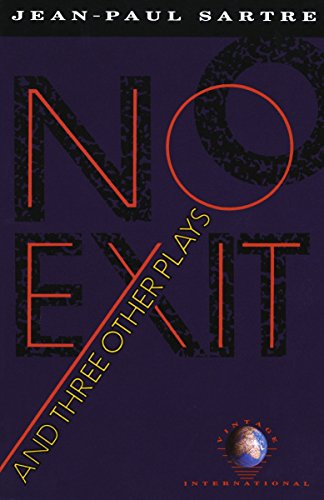
Better than a summary
No Exit and Three Other Plays summary
No credit card required · Cancel anytime
No Exit and Three Other Plays is a collection of existentialist plays by Jean-Paul Sartre. From the famous depiction of hell in "No Exit" to the exploration of freedom and responsibility, these plays delve into the complexities of human existence.
Table of Contents
- No Exit and Three Other Plays: summary of key ideas
- What is No Exit and Three Other Plays about?
- No Exit and Three Other Plays Review
- Who should read No Exit and Three Other Plays?
- About the author
- Book summaries like No Exit and Three Other Plays
- People also liked these summaries
- No Exit and Three Other Plays FAQs
No Exit and Three Other Plays
Summary of key ideas
No Exit: A Play in One Act
In No Exit, Jean-Paul Sartre presents a unique vision of hell. Three characters, Garcin, Inès, and Estelle, find themselves in a room with no windows, no mirrors, and no way out. They soon realize that they are each other's torturers, as they are forced to confront their own flaws and the flaws of the others. The play explores the existentialist themes of freedom, responsibility, and the nature of human relationships.
As the characters reveal their pasts, it becomes clear that they are in hell not because of their actions, but because of their inability to accept responsibility for them. Garcin, a cowardly journalist, is tormented by his desertion during a war. Inès, a manipulative postal clerk, revels in her ability to cause suffering. Estelle, a shallow socialite, is consumed by her need for male attention. Their interactions are intense and revealing, highlighting the complexities of human nature.
The Flies: A Play
In The Flies, Sartre reimagines the Greek myth of Orestes and Electra. Orestes returns to his hometown, Argos, to avenge his father's murder by his mother, Clytemnestra, and her lover, Aegisthus. However, instead of following the traditional narrative, Sartre uses the story to explore existentialist themes. He emphasizes the importance of individual choice and the rejection of predetermined roles.
Unlike the original myth, where the gods dictate Orestes' actions, Sartre's Orestes is free to choose his path. He encourages the townspeople to reject their passivity and take responsibility for their lives. The play's title, The Flies, refers to the metaphorical flies that represent the burden of guilt and the need for action. Sartre's adaptation is a powerful critique of blind obedience and the consequences of inaction.
Dirty Hands: A Play
Dirty Hands is set during a fictional revolution in an unnamed country. The protagonist, Hugo, is a young communist leader who is ordered to assassinate a fellow party member, Hoederer. Hugo initially refuses, citing his moral objections to the act. However, he eventually carries out the assassination, believing it to be a necessary sacrifice for the greater good.
The play explores the conflict between personal ethics and political expediency. Sartre uses Hugo's internal struggle to highlight the complexities of revolutionary politics. The characters are forced to make difficult choices, and their actions are often morally ambiguous. Sartre's message is clear: in the pursuit of political ideals, individuals must confront their 'dirty hands' and accept the consequences of their actions.
The Respectful Prostitute: A Play
In The Respectful Prostitute, Sartre addresses the issue of racial discrimination in the American South. The play revolves around Lizzie, a black prostitute who is arrested for killing a white man in self-defense. The local authorities, including the sheriff and the district attorney, exploit the situation to further their own racist agendas.
Despite the evidence supporting Lizzie's innocence, the white community is determined to see her convicted. The play exposes the hypocrisy and injustice of the Jim Crow era, where racial prejudice and systemic oppression reign. Sartre's portrayal of the characters and their motivations serves as a scathing critique of racism and the abuse of power.
In conclusion, No Exit and Three Other Plays offers a compelling exploration of existentialist philosophy and its application to various social and political contexts. Sartre's characters are complex and flawed, grappling with the weight of their choices and the consequences of their actions. The plays challenge us to confront our own 'no exit' situations and take responsibility for our lives, regardless of the circumstances.
More knowledge in less time

Read or listen
Get the key ideas from nonfiction bestsellers in minutes, not hours.

Find your next read
Get book lists curated by experts and personalized recommendations.

Shortcasts
We've teamed up with podcast creators to bring you key insights from podcasts.
What is No Exit and Three Other Plays about?
No Exit and Three Other Plays is a collection of thought-provoking plays by Jean-Paul Sartre. In the titular play, three characters find themselves in a mysterious room in hell, forced to confront their own actions and the consequences of their choices. The other plays in the collection, The Flies, Dirty Hands, and The Respectful Prostitute, also delve into existential themes and moral dilemmas, making this book a compelling exploration of human nature.
No Exit and Three Other Plays Review
No Exit and Three Other Plays (1944) by Jean-Paul Sartre explores the depths of human existence and the complex dynamics of relationships. Here's why this book is worth reading:
- It presents a vivid depiction of the human condition through thought-provoking and intense stories, making it an intriguing and captivating read.
- With its philosophical themes and moral dilemmas, the book challenges readers to question the nature of freedom, choice, and responsibility.
- The plays' intense dialogue and well-crafted characters create an immersive experience, keeping readers engaged and invested in the emotional journey.
Who should read No Exit and Three Other Plays?
- Readers who enjoy thought-provoking and philosophical plays
- Those interested in existentialism and the human condition
- People looking for deep and introspective literature
Categories with No Exit and Three Other Plays
Book summaries like No Exit and Three Other Plays
 The Laws of SimplicityJohn MaedaDesign, Technology, Business, Life3.8
 On Being Peter AtkinsA Scientist's Exploration of the Great Questions of Existence3.3
 Do No Harm Henry MarshStories of Life, Death, and Brain Surgery4.2
 LeviathanThomas HobbesTeaser: Thomas Hobbes' classic4.5
 Doubt: A HistoryJennifer Michael HechtThe Great Doubters and Their Legacy of Innovation from Socrates and Jesus to Thomas Jefferson and Emily Dickinson3.6
 The Wisdom of InsecurityAlan WattsA Message for an Age of Anxiety4.4
 What Makes Us Human?Charles Pasternak, editorThe Reasons Why We are So Different4.0
 Zen Mind, Beginner’s MindShunryu SuzukiInformal Talks on Zen Meditation and Practice4.4
 The Daily StoicRyan Holiday, Stephen Hanselman366 Meditations on Wisdom, Perseverance, and the Art of Living 4.7
 At the Existentialist CaféSarah BakewellFreedom, Being and Apricot Cocktails 4.6
 Madness and CivilizationMichel FoucaultA History of Insanity in the Age of Reason4.4
 The Why CaféJohn P. StreleckyA Story About the Meaning of Life4.4
 Discipline & PunishMichel FoucaultThe Birth of the Prison4.3
 Great ThinkersThe School of Life, Alain de Botton (series editor)Simple Tools from Sixty Great Thinkers to Improve Your Life Today4.2
 The Origins of TotalitarianismHannah ArendtHannah Arendt's landmark work about Europe's anti-Semitic and imperialist roots4.6
 ConsciousAnnaka HarrisA Brief Guide to the Fundamental Mystery of the Mind4.3
 The Second MountainDavid BrooksThe Quest for a Moral Life4.4
 Stillness Is the KeyRyan HolidayTeaser: Timeless Stoic and Buddhist philosophy4.6
 A Brief History of ThoughtLuc FerryA Philosophical Guide to Living4.3
 To Have or To Be?Erich FrommTeaser: A classic about the psyche and socioeconomic change4.5
 Everything Is F*ckedMark MansonA Book About Hope4.3
 Doing PhilosophyTimothy WilliamsonFrom Common Curiosity to Logical Reasoning4.2
 The Art of LogicEugenia ChengHow to Make Sense in a World that Doesn't4.0
 Capitalism and FreedomMilton FriedmanTeaser: The definitive statement of Friedman's immensely influential economic philosophy4.3
 TruthHector MacdonaldHow the Many Sides to Every Story Shape Our Reality4.3
 On Having No HeadDouglas E. HardingZen and the Rediscovery of the Obvious3.8
 Status AnxietyAlain de BottonTeaser: How social isolation and meritocracy cause fear of underachievement and how to solve this4.5
 The Way of ZenAlan W. WattsTeaser: The history and core principles of the Eastern philosophy of Zen4.5
 Descartes’ ErrorAntonio DamasioEmotion, Reason and the Human Brain4.5
 A Biography of LonelinessFay Bound AlbertiThe History of an Emotion4.0
People ❤️ Blinkist
Become a member of our community of 44 million people

96k ratings

73k ratings
Thi Viet Quynh N.
Great app. Good selection of book summaries you can read or listen to while commuting. Instead of scrolling through your social media news feed, this is a much better way to spend your spare time in my opinion.
Laura H.
When I saw Blinkist had produced an infographic style Blink for the Rich Dad, Poor Dad book, it was a good reminder of the concepts I loved.
Renee D.
I'm absolutely thrilled that Blinkist now offers infographics! I can't get enough of them—they're such a fun and effective way to grasp and remember key points.
People also liked these summaries
 A Canticle for LeibowitzWalter M. Miller
 The Boy in the Striped PajamasJohn BoyneTeaser: Heartbreaking Truths Unfold in a Tale of Friendship and Innocence4.9
 Little House in the Big WoodsLaura Ingalls Wilder
 Wide Sargasso SeaJean Rhys, Judith L. Raiskin
 Just After SunsetStephen King
 WhereaboutsJhumpa Lahiri
 Hearts in DarknessLaura Kaye
 Every Heart a DoorwaySeanan McGuire
 The Curious Case of Benjamin ButtonF. Scott Fitzgerald, Nunzio DeFilippis
 Side JobsJim Butcher
 Brokeback MountainAnnie Proulx
 A Single ManChristopher Isherwood
 And Every Morning the Way Home Gets Longer and LongerFredrik Backman, Alice Menzies
 Burning ChromeWilliam Gibson
 Hearts in AtlantisStephen King
 Bonjour TristesseFrancoise Sagan
 Chronicle of a Death ForetoldGabriel García Márquez, Gregory Rabassa
 For Whom the Bell TollsErnest Hemingway
 The Last QuestionIsaac Asimov
 The 5th WaveRick Yancey
 The Killer AngelsMichael Shaara
 The Martian ChroniclesRay Bradbury
 Cloud AtlasDavid Mitchell
 The Forever WarJoe Haldeman
 I, RobotIsaac Asimov
 Kill SwitchPenelope Douglas
 The Alice NetworkKate Quinn
 Number the StarsLois Lowry
 The SympathizerViet Thanh Nguyen
 City of ThievesDavid Benioff
Trusted by the world's leading brands

Powerful ideas from top nonfiction
Try Blinkist to get the key ideas from 7,500+ bestselling nonfiction titles and podcasts. Listen or read in just 15 minutes.
Get started
Blink 3 of 8 - The 5 AM Club
by Robin Sharma
No Exit and Three Other Plays FAQs
What is the main message of No Exit and Three Other Plays?
The main message of No Exit and Three Other Plays is the exploration of existentialist themes such as freedom, responsibility, and the nature of human existence.
How long does it take to read No Exit and Three Other Plays?
The reading time for No Exit and Three Other Plays varies depending on the reader's speed, but it typically takes several hours. However, the Blinkist summary can be read in just 15 minutes.
Is No Exit and Three Other Plays a good book? Is it worth reading?
No Exit and Three Other Plays is a thought-provoking collection that delves into the complexities of human existence. It offers valuable insights and is definitely worth reading.
Who is the author of No Exit and Three Other Plays?
The author of No Exit and Three Other Plays is Jean-Paul Sartre.