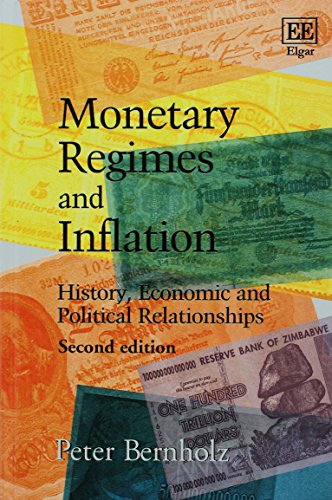
Better than a summary
Monetary Regimes and Inflation summary
Peter Bernholz
No credit card required · Cancel anytime
Monetary Regimes and Inflation by Peter Bernholz provides a comprehensive analysis of different monetary systems and their impact on inflation. It offers valuable insights for policymakers, economists, and anyone interested in understanding the causes of inflation.
Topics
Table of Contents
- Monetary Regimes and Inflation: summary of key ideas
- What is Monetary Regimes and Inflation about?
- Monetary Regimes and Inflation Review
- Who should read Monetary Regimes and Inflation?
- About the author
- Book summaries like Monetary Regimes and Inflation
- People also liked these summaries
- Monetary Regimes and Inflation FAQs
Monetary Regimes and Inflation
Summary of key ideas
Understanding the Nature of Inflation
In Monetary Regimes and Inflation by Peter Bernholz, we embark on a comprehensive journey through the history of inflation, exploring its causes, consequences, and the role of monetary regimes in its management. Bernholz begins by defining inflation as a sustained increase in the general price level of goods and services in an economy. He then delves into the various forms of inflation, such as hyperinflation, moderate inflation, and deflation, and their respective impacts on economies.
Bernholz argues that inflation is primarily a monetary phenomenon, and its root cause lies in the excessive creation of money. He introduces the concept of the inflationary bias, which refers to the tendency of governments to create money to finance their expenditures, leading to inflation. He also discusses the role of central banks in controlling inflation through monetary policy, such as adjusting interest rates and regulating the money supply.
Historical Perspectives on Inflation
Next, Monetary Regimes and Inflation takes us on a historical tour of inflation, starting from ancient Rome to the modern era. Bernholz highlights the monetary regimes prevalent in different periods, such as metallic currencies, the gold standard, and fiat money, and their impact on inflation. He provides detailed case studies of hyperinflations, including those in Germany (1923), Hungary (1946), and Zimbabwe (2008), to illustrate the devastating effects of uncontrolled inflation.
Throughout these historical accounts, Bernholz emphasizes the crucial role of political institutions and economic policies in determining the stability of monetary regimes. He argues that hyperinflations are often the result of political instability, war, or misguided economic policies, rather than inherent flaws in the monetary system itself.
Monetary Regimes and Inflation
In the latter part of the book, Bernholz focuses on the relationship between monetary regimes and inflation. He compares the inflationary tendencies of different monetary systems, highlighting their strengths and weaknesses in controlling inflation. For instance, while metallic currencies are less prone to inflation due to their intrinsic value, they are inflexible and can hinder economic growth. On the other hand, fiat money offers more flexibility but is susceptible to abuse by governments.
Bernholz also discusses the concept of inflation-stable monetary regimes, which are characterized by low and stable inflation rates over extended periods. He identifies certain conditions, such as independent central banks, credible monetary policies, and fiscal discipline, that are essential for maintaining such regimes. He further explores the challenges in transitioning from high inflation to an inflation-stable regime, emphasizing the need for political will and public support.
Concluding Thoughts
In conclusion, Monetary Regimes and Inflation by Peter Bernholz provides a comprehensive analysis of inflation, its historical manifestations, and the role of monetary regimes in managing it. Bernholz’s work underscores the importance of sound economic and political institutions in maintaining stable monetary regimes and controlling inflation. He leaves us with a sobering reminder of the devastating consequences of hyperinflation and the imperative of learning from history to avoid repeating past mistakes.
More knowledge in less time

Read or listen
Get the key ideas from nonfiction bestsellers in minutes, not hours.

Find your next read
Get book lists curated by experts and personalized recommendations.

Shortcasts
We've teamed up with podcast creators to bring you key insights from podcasts.
What is Monetary Regimes and Inflation about?
Monetary Regimes and Inflation by Peter Bernholz provides a comprehensive analysis of the relationship between different monetary systems and inflation. Bernholz examines historical examples and theoretical frameworks to uncover the factors that contribute to inflation and hyperinflation. This book offers valuable insights for economists, policymakers, and anyone interested in understanding the complexities of monetary policy.
Monetary Regimes and Inflation Review
Monetary Regimes and Inflation (2003) is an informative and insightful book that explores the relationship between monetary systems and inflation. Here's why this book is worth reading:
- With detailed historical analysis and comprehensive data, it provides a thorough understanding of how different monetary regimes impact inflation rates.
- Peter Bernholz, a renowned economist, combines theoretical knowledge with practical examples, making the book accessible and applicable to real-world situations.
- The book presents a fascinating exploration of the complex factors that contribute to inflation, making it an engaging read for those interested in economics.
Who should read Monetary Regimes and Inflation?
- Economists and policymakers seeking to understand the causes and consequences of inflation
- Students and academics studying monetary theory and historical monetary regimes
- Individuals interested in the relationship between government policies and inflation
Categories with Monetary Regimes and Inflation
Book summaries like Monetary Regimes and Inflation
 Basic EconomicsThomas SowellA Common Sense Guide to the Economy4.4
 Think and Grow RichNapoleon HillThe secrets of 40 millionaires' wealth, revealed4.4
 Rich Dad, Poor DadRobert T. KiyosakiWhat the Rich Teach Their Kids about Money – That the Poor and the Middle Class Do Not!4.5
 Secrets of the Millionaire MindT. Harv EkerMastering the Inner Game of Wealth4.1
 Business AdventuresJohn BrooksTwelve Classic Tales from the World of Wall Street4.3
 The Most Important ThingHoward MarksUncommon Sense for the Thoughtful Investor4.1
 More Money Than GodSebastian MallabyHedge Funds and the Making of a New Elite4.2
 The Misbehavior of MarketsBenoit Mandelbrot and Richard L. HudsonA Fractal View of Risk, Ruin and Reward4.3
 Zillow TalkSpencer Rascoff and Stan HumphriesThe New Rules of Real Estate3.6
 I Will Teach You To Be RichRamit SethiThe easy approach to smart banking, saving, spending and investing3.9
 The Intelligent InvestorBenjamin Graham and comments by Jason ZweigThe Definitive Book on Value Investing4.4
 The Dao of CapitalMark SpitznagelAustrian Investing in a Distorted World4.3
 The Education of a Value InvestorGuy SpierMy Transformative Quest for Wealth, Wisdom and Enlightenment4.3
 Common Stocks and Uncommon Profits and Other WritingsPhilip A. FischerImprove your investment strategy4.2
 Rule #1Phil TownThe Simple Strategy For Successful Investing In Only 15 Minutes Every Week4.2
People ❤️ Blinkist
Become a member of our community of 44 million people

96k ratings

73k ratings
Jonathan A.
Clearly communicates the value proposition of the most popular book summaries and offers a relatable, tangible template that I can use immediately.
Laura H.
When I saw Blinkist had produced an infographic style Blink for the Rich Dad, Poor Dad book, it was a good reminder of the concepts I loved.
Guillem B.
Life changing. The concept of being able to grasp a book's main point in such a short time truly opens multiple opportunities to grow every area of your life at a faster rate.
People also liked these summaries
 When Genius FailedRoger LowensteinThe Rise and Fall of Long-Term Capital Management4.1
 Millennial MoneyPatrick O’ShaughnessyHow Young Investors Can Build a Fortune3.9
 The Little Book of Common Sense InvestingJohn C. BogleThe Only Way to Guarantee Your Fair Share of Stock Market Returns 4.3
 The Total Money MakeoverDave RamseyA Proven Plan for Finance Fitness4.2
 The Economist: Numbers GuideRichard Stutely & The EconomistThe Essentials of Business Numeracy4.0
 Second ChanceRobert T. KiyosakiFor Your Money, Your Life and Our World4.3
 The Millionaire Next DoorThomas J. Stanley and William D. DankoThe Surprising Secrets of America’s Wealthy3.9
 Picture Your ProsperityEllen Rogin and Lisa KuengSmart Money Moves to Turn Your Vision into Reality 3.9
 The New Trading for a LivingDr. Alexander ElderPsychology, Discipline, Trading Tools and Systems, Risk Control, Trade Management4.1
 Berkshire Beyond BuffettLawrence A. CunninghamThe Enduring Value of Values4.1
 Cut Costs Not CornersColin BarrowA practical guide to staying competitive and improving profits3.8
 The One-Page Financial PlanCarl RichardsA Simple Way to Be Smart About Your Money4.0
 Outsmarting the CrowdBogumil K. BaranowskiA Value Investor’s Guide to Starting, Building, and Keeping a Family Fortune4.2
 Buying Your First HomeIlona Bray, Alayna Schroeder and Marcia StewartNolo's Essential Guide4.0
 A Wealth of Common SenseBen CarlsonWhy Simplicity Trumps Complexity in Any Investment Plan4.1
Trusted by the world's leading brands

Powerful ideas from top nonfiction
Try Blinkist to get the key ideas from 7,500+ bestselling nonfiction titles and podcasts. Listen or read in just 15 minutes.
Get started
Blink 3 of 8 - The 5 AM Club
by Robin Sharma
Monetary Regimes and Inflation FAQs
What is the main message of Monetary Regimes and Inflation?
The main message of Monetary Regimes and Inflation is how monetary policy affects inflation rates and economic stability.
How long does it take to read Monetary Regimes and Inflation?
The reading time for Monetary Regimes and Inflation depends on the reader's pace. However, the Blinkist summary can be read in a short time.
Is Monetary Regimes and Inflation a good book? Is it worth reading?
Monetary Regimes and Inflation is a worthwhile read for anyone interested in understanding the relationship between monetary policy and inflation.
Who is the author of Monetary Regimes and Inflation?
The author of Monetary Regimes and Inflation is Peter Bernholz.