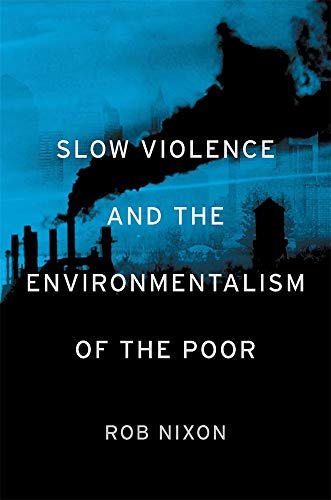
Better than a summary
Slow Violence and the Environmentalism of the Poor summary
Rob Nixon
No credit card required · Cancel anytime
Slow Violence and the Environmentalism of the Poor by Rob Nixon sheds light on the often overlooked forms of environmental violence that disproportionately affect marginalized communities. It calls for a more inclusive and comprehensive environmentalism.
Topics
Table of Contents
- Slow Violence and the Environmentalism of the Poor: summary of key ideas
- What is Slow Violence and the Environmentalism of the Poor about?
- Slow Violence and the Environmentalism of the Poor Review
- Who should read Slow Violence and the Environmentalism of the Poor?
- About the author
- Book summaries like Slow Violence and the Environmentalism of the Poor
- People also liked these summaries
- Slow Violence and the Environmentalism of the Poor FAQs
Slow Violence and the Environmentalism of the Poor
Summary of key ideas
The Undetectable Violence of Environmental Degradation
In Slow Violence and the Environmentalism of the Poor, Rob Nixon introduces the concept of 'slow violence' - a form of violence that is neither spectacular nor instantaneous, but rather incremental and accretive. He argues that this type of violence is often overlooked due to its undetectable nature and its adverse effects on the environment and the lives of the poor, marginalized, and dispossessed.
Nixon draws attention to environmental disasters such as deforestation, toxic contamination, and climate change, which unfold gradually and often in remote locations. He emphasizes that these disasters have a long-term, slow erosion effect on ecosystems and human health, especially in impoverished areas where the poor and marginalized are disproportionately affected.
The Disproportionate Burden on the Marginalized
In the second part of the book, Nixon examines how slow violence exacerbates social inequalities. He provides a detailed account of the Ogoni people in Nigeria, who suffered from the environmental degradation caused by oil extraction. The Ogoni case serves as an illustration of how the poor and marginalized are forced to bear the brunt of environmental violence, often at the hands of multinational corporations and complicit governments.
Nixon further explores the disproportionate impact of slow violence on indigenous communities, who are often forced to relocate due to environmental degradation caused by large-scale development projects. He argues that these communities, despite being the least responsible for environmental degradation, are the most affected due to their reliance on local ecosystems for survival.
The Environmentalism of the Poor
In the latter part of Slow Violence, Nixon presents the concept of the 'environmentalism of the poor'. He highlights the resilience and resistance of marginalized communities in the face of slow violence, discussing how they mobilize to protect their environment and livelihoods. These grassroots movements, Nixon argues, represent a form of environmentalism that challenges traditional, mainstream environmental movements and policies.
Nixon concludes by emphasizing the importance of recognizing and addressing slow violence. He calls for a more inclusive and empathetic environmentalism that acknowledges the interconnectedness of social and ecological systems. He also advocates for a shift in our perception of time, urging us to consider the long-term, intergenerational impacts of environmental degradation.
Reimagining Environmental Justice
In sum, Slow Violence and the Environmentalism of the Poor challenges us to rethink our understanding of environmental violence and justice. By shedding light on the often-invisible, slow violence inflicted on marginalized communities and ecosystems, Nixon urges us to broaden our scope of environmental activism and policy-making. He encourages us to listen to the voices of the poor and marginalized, acknowledging their unique experiences and perspectives in our collective efforts towards a more just and sustainable future.
More knowledge in less time

Read or listen
Get the key ideas from nonfiction bestsellers in minutes, not hours.

Find your next read
Get book lists curated by experts and personalized recommendations.

Shortcasts
We've teamed up with podcast creators to bring you key insights from podcasts.
What is Slow Violence and the Environmentalism of the Poor about?
Slow Violence and the Environmentalism of the Poor by Rob Nixon explores the often overlooked forms of environmental destruction and their impact on marginalized communities. Through in-depth analysis and compelling storytelling, Nixon sheds light on the concept of 'slow violence' and advocates for a more inclusive and proactive approach to environmental activism.
Slow Violence and the Environmentalism of the Poor Review
- It uncovers the invisible crises caused by slow violence, compelling readers to rethink traditional views on environmental issues.
- The book highlights the resilience of disadvantaged populations facing these challenges, offering a new perspective on environmental activism.
- Through its compelling narratives and case studies, the book keeps readers engaged and informed, proving that environmental justice is a vital, urgent cause.
Who should read Slow Violence and the Environmentalism of the Poor?
Environmental activists and scholars seeking a deeper understanding of ecological justice
Policy makers and advocates looking to address the systemic and long-term impacts of environmental degradation
Readers interested in the intersection of environmental issues with social inequality and global politics
Categories with Slow Violence and the Environmentalism of the Poor
Book summaries like Slow Violence and the Environmentalism of the Poor
 Where Good Ideas Come FromSteven JohnsonThe Natural History of Innovation4.1
 God is not greatChristopher HitchensHow Religion Poisons Everything3.9
 A Brief History of Time Stephen HawkingFrom the Big Bang to Black Holes4.4
 The Selfish GeneRichard DawkinsA landmark work in the field of biology and evolution4.4
 AntifragileNassim Nicholas TalebThings That Gain from Disorder4.5
 Physics of the futureMichio KakuHow Science Will Shape Human Destiny and Our Daily Lives by the Year 21004.1
 MusicophiliaOliver SacksTales of Music and the Brain, Revised and Expanded Edition4.3
 How Music Works David ByrneHow circumstance and creativity collide in tune4.4
 The Sports GeneDavid EpsteinInside the Science of Extraordinary Athletic Performance4.3
 On intelligence Jeff Hawkins, Sandra BlakesleeHow a New Understanding of the Brain Will Lead to the Creation of Truly Intelligent Machines3.9
 Nutrition and Physical DegenerationWeston Andrew PriceA Comparison of Primitive and Modern Diets and their Effects4.2
 GutGiulia EndersThe Inside Story of Our Body’s Most Underrated Organ4.3
 Bad ScienceBen GoldacreA behind-the-scenes look at the bogus science used to mislead us every day.4.4
 Moonwalking with EinsteinJoshua FoerThe Art and Science of Remembering Everything4.2
 Do No Harm Henry MarshStories of Life, Death, and Brain Surgery4.2
People ❤️ Blinkist
Become a member of our community of 44 million people

96k ratings

73k ratings
Thi Viet Quynh N.
Great app. Good selection of book summaries you can read or listen to while commuting. Instead of scrolling through your social media news feed, this is a much better way to spend your spare time in my opinion.
Renee D.
I'm absolutely thrilled that Blinkist now offers infographics! I can't get enough of them—they're such a fun and effective way to grasp and remember key points.
Sven O.
It's highly addictive to get core insights on personally relevant topics without repetition or triviality. Added to that the apps ability to suggest kindred interests opens up a foundation of knowledge.
People also liked these summaries
 Fluent ForeverGabriel WynerHow to Learn Any Language Fast and Never Forget It4.3
 Life at the Speed of Light J. Craig VenterFrom the Double Helix to the Dawn of Digital Life4.3
 The Language InstinctSteven PinkerHow the Mind Creates Language4.0
 A mind for numbersBarbara OakleyHow to Excel at Math and Science (Even If You Flunked Algebra)4.3
 The Structure of Scientific RevolutionsThomas S. KuhnA groundbreaking study in how science progresses4.3
 SmarterDan HurleyThe New Science of Building Brain Power3.6
 An Astronaut’s Guide to Life on EarthChris HadfieldWhat Going to Space Taught Me About Ingenuity, Determination, and Being Prepared for Anything3.9
 The Demon-Haunted WorldCarl SaganScience as a Candle in the Dark4.3
 Moore’s LawArnold Thackray, David Brock and Rachel JonesThe Life of Gordon Moore, Silicon Valley’s Quiet Revolutionary4.3
 Grain BrainDavid PerlmutterThe Surprising Truth about Wheat, Carbs, and Sugar4.3
 What If?Randall MunroeSerious Scientific Answers to Absurd Hypothetical Questions3.4
 On ImmunityEula BissAn Inoculation3.3
 Sonic BoomJoel Beckerman (Autor), Tyler GrayHow Sound Transforms the Way We Think, Feel, and Buy3.4
 Consider the ForkBee WilsonHow Technology Transforms the Way We Cook and Eat3.8
 Driven Paul Lawrence & Nitin NohriaHow Human Nature Shapes our Choices3.6
Trusted by the world's leading brands

Powerful ideas from top nonfiction
Try Blinkist to get the key ideas from 7,500+ bestselling nonfiction titles and podcasts. Listen or read in just 15 minutes.
Get started
Blink 3 of 8 - The 5 AM Club
by Robin Sharma