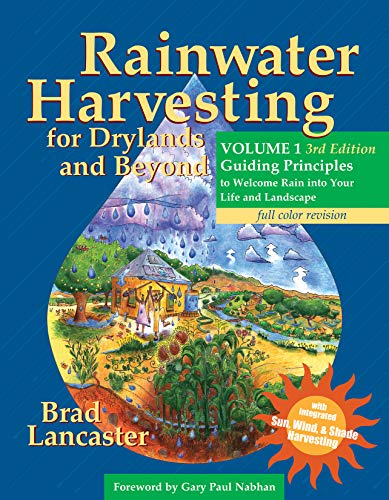
Better than a summary
Rainwater Harvesting for Drylands and Beyond, Volume 1 summary
Brad Lancaster
No credit card required · Cancel anytime
Rainwater Harvesting for Drylands and Beyond, Volume 1 by Brad Lancaster is a comprehensive guide that offers practical techniques for capturing and utilizing rainwater to create sustainable and drought-resistant landscapes. It provides valuable insights and step-by-step instructions for implementing effective rainwater harvesting systems.
Table of Contents
- Rainwater Harvesting for Drylands and Beyond, Volume 1: summary of key ideas
- What is Rainwater Harvesting for Drylands and Beyond, Volume 1 about?
- Rainwater Harvesting for Drylands and Beyond, Volume 1 Review
- Who should read Rainwater Harvesting for Drylands and Beyond, Volume 1?
- About the author
- Book summaries like Rainwater Harvesting for Drylands and Beyond, Volume 1
- People also liked these summaries
- Rainwater Harvesting for Drylands and Beyond, Volume 1 FAQs
Rainwater Harvesting for Drylands and Beyond, Volume 1
Summary of key ideas
Understanding Water-Harvesting Basics
In Rainwater Harvesting for Drylands and Beyond, Volume 1 by Brad Lancaster, the author begins by introducing the reader to the concept of rainwater harvesting. He explains the importance of capturing and using rainwater, especially in arid regions where water is scarce. Lancaster emphasizes the need for a shift in our approach to water management, moving away from centralized systems to decentralized, site-specific solutions that mimic natural processes.
The author then delves into the fundamentals of water-harvesting, discussing key elements such as soil, vegetation, and topography. He highlights the role of these components in capturing, storing, and using rainwater effectively. Lancaster stresses the importance of understanding your local environment and site-specific conditions to implement the most suitable water-harvesting strategies.
Integrating Water-Harvesting Techniques
Lancaster then proceeds to explore various water-harvesting techniques, starting with earthworks. He explains how simple modifications to the landscape, such as swales and berms, can significantly enhance rainwater infiltration and retention. The author also introduces the concept of planting water, advocating for the use of native, water-efficient vegetation to further improve water retention and soil health.
Continuing this exploration, Lancaster discusses the role of passive water-harvesting systems, such as roof catchment, in capturing rainwater. He provides practical advice on designing and implementing these systems, stressing the importance of integrating them with other water-harvesting techniques. Lancaster emphasizes the need for a comprehensive, holistic approach to water-harvesting, considering both the built and natural environment.
Practical Application and Case Studies
Next, the author moves on to the practical application of water-harvesting techniques. He provides detailed guidance on assessing your site, designing a water-harvesting plan, and selecting appropriate techniques. Lancaster encourages the reader to start small, experiment, and learn from their experiences, gradually expanding their water-harvesting efforts.
Throughout the book, Lancaster supplements his teachings with real-life examples and case studies. He introduces us to individuals and communities who have successfully implemented water-harvesting projects, demonstrating the practicality and effectiveness of these techniques. These stories serve as inspiration and highlight the transformative impact of water-harvesting on people's lives and the environment.
Looking Forward
In conclusion, Rainwater Harvesting for Drylands and Beyond, Volume 1 provides a comprehensive introduction to the principles and practices of water-harvesting. Lancaster emphasizes the potential of these techniques to address water scarcity, improve soil health, and create sustainable, resilient landscapes. He encourages readers to embrace a new perspective on water, viewing it not as a problem to be managed but as a valuable resource to be harvested and utilized wisely.
Overall, this volume sets the stage for a deeper exploration of water-harvesting in subsequent volumes, offering a solid foundation of knowledge and principles. It leaves readers with a sense of optimism and empowerment, knowing that they have the tools and understanding to make a positive impact on their local water cycle and contribute to a more sustainable future.
More knowledge in less time

Read or listen
Get the key ideas from nonfiction bestsellers in minutes, not hours.

Find your next read
Get book lists curated by experts and personalized recommendations.

Shortcasts
We've teamed up with podcast creators to bring you key insights from podcasts.
What is Rainwater Harvesting for Drylands and Beyond, Volume 1 about?
Rainwater Harvesting for Drylands and Beyond, Volume 1 by Brad Lancaster is a comprehensive guide to capturing and utilizing rainwater in arid and semi-arid regions. The book offers practical techniques and innovative strategies for harvesting rainwater, making it an invaluable resource for anyone looking to conserve water and create sustainable landscapes.
Rainwater Harvesting for Drylands and Beyond, Volume 1 Review
- Empowering readers with practical techniques and strategies, it equips them to implement rainwater harvesting systems effectively.
- By weaving in local knowledge and global solutions, the book offers a comprehensive approach to water conservation, catering to a wide audience.
- Its illustrative case studies and success stories bring the content to life, ensuring that learning about water sustainability is far from dull.
Who should read Rainwater Harvesting for Drylands and Beyond, Volume 1?
Individuals living in dryland regions who want to maximize their water resources
Gardeners and landscapers looking to create sustainable and water-efficient outdoor spaces
Environmental enthusiasts interested in reducing water waste and promoting conservation
Categories with Rainwater Harvesting for Drylands and Beyond, Volume 1
Book summaries like Rainwater Harvesting for Drylands and Beyond, Volume 1
 Big DataMayer-Schonberger, CukierA Revolution That Will Transform How We Live, Work and Think4.3
 On intelligence Jeff Hawkins, Sandra BlakesleeHow a New Understanding of the Brain Will Lead to the Creation of Truly Intelligent Machines3.9
 The Signal and the NoiseNate SilverWhy So Many Predictions Fail — but Some Don't4.2
 You Are Not a GadgetJaron LanierA Manifesto3.9
 The Future of the MindMichio KakuThe Scientific Quest to Understand, Enhance, and Empower the Mind4.4
 Too Big to IgnorePhil SimonThe Business Case for Big Data4.1
 The Intel TrinityMichael S. MaloneHow Robert Noyce, Gordon Moore and Andy Grove Built the World’s Most Important Company4.2
 BreakpointJeff StibelWhy the Web will Implode, Search will be Obsolete, and Everything Else you Need to Know about Technology is in Your Brain4.0
 Information Doesn’t Want to Be FreeCory DoctorowLaws for the Internet Age3.6
 The Master AlgorithmPedro DomingosHow The Quest For The Ultimate Learning Machine Will Remake Our World4.4
 The InevitableKevin KellyUnderstanding the 12 Technological Forces That Will Shape Our Future4.2
 StretchKarie Willyerd and Barbara MistickHow to Future-Proof Yourself for Tomorrow’s Workplace3.8
 The Filter BubbleEli PariserWhat the Internet is Hiding From You4.0
 IrresistibleAdam AlterThe Rise of Addictive Technology and the Business of Keeping Us Hooked4.2
 The Innovator’s HypothesisMichael SchrageHow Cheap Experiments Are Worth More than Good Ideas3.8
People ❤️ Blinkist
Become a member of our community of 44 million people

96k ratings

73k ratings
Renee D.
I'm absolutely thrilled that Blinkist now offers infographics! I can't get enough of them—they're such a fun and effective way to grasp and remember key points.
Jonathan A.
Clearly communicates the value proposition of the most popular book summaries and offers a relatable, tangible template that I can use immediately.
Thi Viet Quynh N.
Great app. Good selection of book summaries you can read or listen to while commuting. Instead of scrolling through your social media news feed, this is a much better way to spend your spare time in my opinion.
People also liked these summaries
 Age of DiscoveryIan Goldin (Author), Chris KutarnaNavigating the Risks and Rewards of Our New Renaissance 4.3
 Sensemakingby Christian MadsbjergWhat Makes Human Intelligence Essential in the Age of the Algorithm4.0
 UX StrategyJaime LevyHow to Devise Innovative Digital Products That People Want 4.1
 Weapons of Math DestructionCathy O'NeilHow Big Data Increases Inequality and Threatens Democracy4.1
 VaporizedRobert TercekSolid Strategies For Success in a Dematerialized World4.4
 The Dark NetJamie BartlettInside the Digital Underworld3.1
 Changing the SubjectSven BirkertsArt and Attention in the Internet Age4.1
 Streaming, Sharing, StealingMichael D. Smith and Rahul TelangBig Data and the Future of Entertainment3.5
 The Distracted MindAdam Gazzaley, Larry D. RosenAncient Brains in a High-Tech World4.1
 Life 3.0Max TegmarkBeing Human in the Age of Artificial Intelligence 4.3
 The Age of Spiritual MachinesRay KurzweilWhen Computers Exceed Human Intelligence4.3
 Bad BloodJohn CarreyrouSecrets and Lies in a Silicon Valley Startup4.2
 The One DeviceBrian MerchantThe Secret History of the iPhone3.6
 BuiltRoma AgrawalThe Hidden Stories Behind our Structures4.6
 Ghost in the WiresKevin D. Mitnick, William L. Simon, Steve WozniakMy Adventures as the World's Most Wanted Hacker4.5
Trusted by the world's leading brands

Powerful ideas from top nonfiction
Try Blinkist to get the key ideas from 7,500+ bestselling nonfiction titles and podcasts. Listen or read in just 15 minutes.
Get started
Blink 3 of 8 - The 5 AM Club
by Robin Sharma