Better than a summary
Poorly Made in China summary
Paul Midler
No credit card required · Cancel anytime
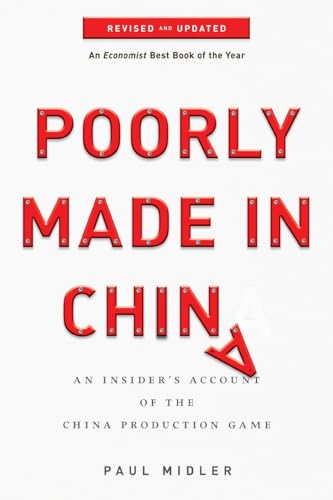
Poorly Made in China by Paul Midler is a revealing account of the challenges and pitfalls of doing business in China. It explores the cultural and ethical issues that arise in manufacturing and offers valuable insights for anyone dealing with Chinese suppliers.
Topics
Poorly Made in China
Summary of key ideas
Understanding the Manufacturing Industry in China
In Poorly Made in China, author Paul Midler takes us on a journey through the complexities of manufacturing in China. Midler begins by introducing us to the world of manufacturing, where Western companies outsource their production to Chinese factories to cut costs. What seems like a win-win situation, however, is far from it, as Midler uncovers the intricate web of relationships and practices that hinder the quality of products made in China.
Midler introduces us to the concept of quality fade, a phenomenon where Chinese manufacturers initially produce high-quality products to win contracts but gradually reduce the quality to cut costs and increase profits. This practice, Midler argues, is a result of the lack of trust and long-term commitment between Western companies and their Chinese suppliers. The lack of transparency and accountability further exacerbates the problem.
Dealing with the Quality Fade Phenomenon
Moving on, Poorly Made in China delves deeper into the implications of quality fade. Midler explains how Western companies, often unaware of the gradual decline in product quality, find themselves in a predicament when they finally realize that the products they are selling are subpar. This not only leads to financial losses but also damages the reputation of the Western companies.
Midler also discusses the challenges faced by quality control inspectors in China. He highlights the prevalence of a superficial approach to quality control, where inspectors often focus on appearance rather than functionality. This, he explains, is a reflection of the broader cultural attitude towards quality, where 'good enough' is considered acceptable.
Understanding the Cultural and Business Dynamics
Midler then takes a step back to examine the cultural and business dynamics that contribute to the prevalence of quality fade. He argues that the Chinese culture, deeply rooted in the concept of 'saving face', often leads to a lack of transparency and honesty in business dealings. Moreover, the short-term profit-driven mindset of Chinese manufacturers, coupled with the pressure to compete in a cutthroat market, further perpetuates the problem.
Midler also sheds light on the role of middlemen in the manufacturing process. These middlemen, who act as intermediaries between Western companies and Chinese factories, often prioritize their own profits over the quality of the products. As a result, they encourage and perpetuate the practice of quality fade to maintain their profit margins.
Seeking Solutions and Lessons Learned
As the book progresses, Poorly Made in China shifts its focus towards finding solutions to the quality fade problem. Midler emphasizes the need for Western companies to develop long-term, transparent, and mutually beneficial relationships with their Chinese suppliers. He suggests that building trust and fostering a culture of collaboration and accountability is crucial in addressing the issue.
Midler also encourages Western companies to take a more active role in quality control, suggesting that they should invest in independent quality control processes and maintain a physical presence in the factories they work with. He argues that this hands-on approach is essential in ensuring the consistent quality of products manufactured in China.
Conclusion
In conclusion, Poorly Made in China provides a comprehensive understanding of the challenges and complexities of manufacturing in China. The book serves as a wake-up call for Western companies, urging them to rethink their approach to outsourcing and take proactive measures to address the quality fade problem. By shedding light on the cultural, business, and operational dynamics at play, Midler equips us with valuable insights into the world of manufacturing in China.
More knowledge in less time

Read or listen
Get the key ideas from nonfiction bestsellers in minutes, not hours.

Find your next read
Get book lists curated by experts and personalized recommendations.

Shortcasts
We've teamed up with podcast creators to bring you key insights from podcasts.
What is Poorly Made in China about?
Poorly Made in China by Paul Midler offers a fascinating insider's perspective on the challenges and pitfalls of manufacturing in China. Through real-life anecdotes and insightful analysis, the book sheds light on the deceptive practices, quality issues, and cultural differences that can lead to subpar products. It serves as a cautionary tale for businesses looking to outsource production to China and provides valuable lessons for anyone involved in global trade.
Poorly Made in China Review
- Unveils insider knowledge on the complexities of Chinese manufacturing, revealing eye-opening truths that challenge common perceptions.
- Explores the consequences of outsourcing to China in a thought-provoking manner, making readers rethink their consumer choices.
- With its engaging storytelling and in-depth analysis, the book transforms a potentially dry topic into a riveting exploration of global economics.
Who should read Poorly Made in China?
Business owners and entrepreneurs looking to manufacture products in China
Consumers who want to understand the challenges and risks associated with products made in China
Individuals interested in learning about the complexities of global supply chains and manufacturing processes
Categories with Poorly Made in China
Book summaries like Poorly Made in China
 Where Good Ideas Come FromSteven JohnsonThe Natural History of Innovation4.1
 God is not greatChristopher HitchensHow Religion Poisons Everything3.9
 A Brief History of Time Stephen HawkingFrom the Big Bang to Black Holes4.4
 The Selfish GeneRichard DawkinsA landmark work in the field of biology and evolution4.4
 AntifragileNassim Nicholas TalebThings That Gain from Disorder4.5
 Physics of the futureMichio KakuHow Science Will Shape Human Destiny and Our Daily Lives by the Year 21004.1
 MusicophiliaOliver SacksTales of Music and the Brain, Revised and Expanded Edition4.3
 How Music Works David ByrneHow circumstance and creativity collide in tune4.4
 The Sports GeneDavid EpsteinInside the Science of Extraordinary Athletic Performance4.3
 On intelligence Jeff Hawkins, Sandra BlakesleeHow a New Understanding of the Brain Will Lead to the Creation of Truly Intelligent Machines3.9
 Nutrition and Physical DegenerationWeston Andrew PriceA Comparison of Primitive and Modern Diets and their Effects4.2
 GutGiulia EndersThe Inside Story of Our Body’s Most Underrated Organ4.3
 Bad ScienceBen GoldacreA behind-the-scenes look at the bogus science used to mislead us every day.4.4
 Moonwalking with EinsteinJoshua FoerThe Art and Science of Remembering Everything4.2
 Do No Harm Henry MarshStories of Life, Death, and Brain Surgery4.2
People ❤️ Blinkist
Become a member of our community of 44 million people

96k ratings

73k ratings
Renee D.
I'm absolutely thrilled that Blinkist now offers infographics! I can't get enough of them—they're such a fun and effective way to grasp and remember key points.
Laura H.
When I saw Blinkist had produced an infographic style Blink for the Rich Dad, Poor Dad book, it was a good reminder of the concepts I loved.
Thi Viet Quynh N.
Great app. Good selection of book summaries you can read or listen to while commuting. Instead of scrolling through your social media news feed, this is a much better way to spend your spare time in my opinion.
People also liked these summaries
 Fluent ForeverGabriel WynerHow to Learn Any Language Fast and Never Forget It4.3
 Life at the Speed of Light J. Craig VenterFrom the Double Helix to the Dawn of Digital Life4.3
 The Language InstinctSteven PinkerHow the Mind Creates Language4.0
 A mind for numbersBarbara OakleyHow to Excel at Math and Science (Even If You Flunked Algebra)4.3
 The Structure of Scientific RevolutionsThomas S. KuhnA groundbreaking study in how science progresses4.3
 SmarterDan HurleyThe New Science of Building Brain Power3.6
 An Astronaut’s Guide to Life on EarthChris HadfieldWhat Going to Space Taught Me About Ingenuity, Determination, and Being Prepared for Anything3.9
 The Demon-Haunted WorldCarl SaganScience as a Candle in the Dark4.3
 Moore’s LawArnold Thackray, David Brock and Rachel JonesThe Life of Gordon Moore, Silicon Valley’s Quiet Revolutionary4.3
 Grain BrainDavid PerlmutterThe Surprising Truth about Wheat, Carbs, and Sugar4.3
 What If?Randall MunroeSerious Scientific Answers to Absurd Hypothetical Questions3.4
 On ImmunityEula BissAn Inoculation3.3
 Sonic BoomJoel Beckerman (Autor), Tyler GrayHow Sound Transforms the Way We Think, Feel, and Buy3.4
 Consider the ForkBee WilsonHow Technology Transforms the Way We Cook and Eat3.8
 Driven Paul Lawrence & Nitin NohriaHow Human Nature Shapes our Choices3.6
Trusted by the world's leading brands

Powerful ideas from top nonfiction
Try Blinkist to get the key ideas from 7,500+ bestselling nonfiction titles and podcasts. Listen or read in just 15 minutes.
Get started
Blink 3 of 8 - The 5 AM Club
by Robin Sharma