Better than a summary
Demand Driven Material Requirements Planning summary
Carol Ptak
No credit card required · Cancel anytime
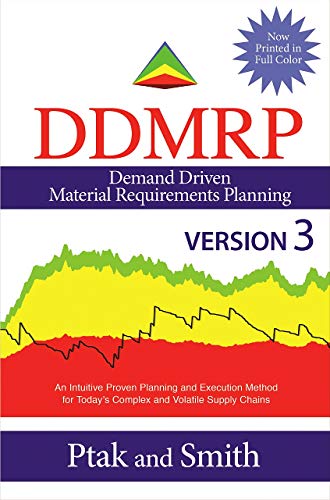
Demand Driven Material Requirements Planning by Carol Ptak provides a comprehensive guide to implementing a demand-driven approach to material and inventory management, offering practical strategies to improve supply chain performance.
Topics
Table of Contents
- Demand Driven Material Requirements Planning: summary of key ideas
- What is Demand Driven Material Requirements Planning about?
- Demand Driven Material Requirements Planning Review
- Who should read Demand Driven Material Requirements Planning?
- About the author
- Book summaries like Demand Driven Material Requirements Planning
- People also liked these summaries
- Demand Driven Material Requirements Planning FAQs
Demand Driven Material Requirements Planning
Summary of key ideas
Understanding the Need for Demand Driven Material Requirements Planning
In Demand Driven Material Requirements Planning, Carol Ptak and Chad Smith introduce us to the concept of DDMRP, a method designed to address the limitations of traditional Material Requirements Planning (MRP) systems. They argue that traditional MRP systems are not well-equipped to handle the challenges of modern supply chains, including variability in demand, long lead times, and complex global networks.
The authors highlight that traditional MRP systems are based on static assumptions, such as stable demand and lead times, which often do not reflect the dynamic realities of today's supply chains. They also emphasize the negative consequences of these assumptions, such as excessive inventory, poor customer service, and inefficient use of resources.
The Principles of Demand Driven Material Requirements Planning
Ptak and Smith then introduce the principles of DDMRP, which are designed to address the shortcomings of traditional MRP systems. The core concept of DDMRP is decoupling the material and information flows, allowing for a more dynamic and responsive approach to planning and execution. They propose a three-tiered structure of inventory positioning, protection, and pull signals, which are designed to align inventory levels with actual demand.
According to the authors, the positioning of inventory is based on the demand and supply variability of each item, ensuring that the right inventory is in the right place at the right time. The protection aspect involves buffering against variability and uncertainty, while the pull signals are used to trigger replenishment based on actual demand rather than forecasts.
Implementing Demand Driven Material Requirements Planning
In the latter part of Demand Driven Material Requirements Planning, Ptak and Smith delve into the practical implementation of DDMRP. They emphasize the need for a cultural shift within organizations, moving from a focus on cost reduction and efficiency to one centered on flow and responsiveness. They also highlight the importance of cross-functional collaboration and the use of appropriate technology in the successful adoption of DDMRP.
Furthermore, the authors provide detailed guidance on the steps involved in implementing DDMRP, including data analysis, inventory segmentation, and the calculation of DDMRP parameters. They also discuss the potential benefits of DDMRP, such as reduced lead times, improved customer service levels, and lower inventory carrying costs.
Case Studies and Real-World Applications
To illustrate the real-world application of DDMRP, Ptak and Smith include several case studies from a range of industries, including automotive, aerospace, and consumer goods. These case studies demonstrate how organizations have successfully implemented DDMRP to address specific challenges in their supply chains and achieve significant improvements in performance.
In conclusion, Demand Driven Material Requirements Planning provides a comprehensive overview of the limitations of traditional MRP systems and the principles and benefits of DDMRP. It serves as a valuable resource for supply chain professionals seeking to adapt their planning and execution processes to the demands of the modern marketplace.
More knowledge in less time

Read or listen
Get the key ideas from nonfiction bestsellers in minutes, not hours.

Find your next read
Get book lists curated by experts and personalized recommendations.

Shortcasts
We've teamed up with podcast creators to bring you key insights from podcasts.
What is Demand Driven Material Requirements Planning about?
Demand Driven Material Requirements Planning by Carol Ptak provides a comprehensive guide to the innovative approach of DDMRP. It offers insights into how traditional MRP systems fall short in today's volatile and complex supply chains and presents a practical methodology to synchronize material flow with actual customer demand. A must-read for professionals seeking to optimize inventory, reduce lead times, and improve supply chain performance.
Demand Driven Material Requirements Planning Review
- Explains the concept of dynamic buffering and how it revolutionizes traditional inventory management methods.
- Provides insights on linking production process to actual demand, optimizing resources and minimizing waste.
- Offers a practical roadmap for organizations to adapt to volatile market demands with agility and efficiency.
Who should read Demand Driven Material Requirements Planning?
Professionals in supply chain management seeking to improve their material requirements planning processes
Manufacturing and distribution companies looking to reduce inventory levels and improve on-time delivery performance
Individuals interested in understanding and implementing demand-driven strategies in their organizations
Categories with Demand Driven Material Requirements Planning
Book summaries like Demand Driven Material Requirements Planning
 Where Good Ideas Come FromSteven JohnsonThe Natural History of Innovation4.1
 God is not greatChristopher HitchensHow Religion Poisons Everything3.9
 A Brief History of Time Stephen HawkingFrom the Big Bang to Black Holes4.4
 The Selfish GeneRichard DawkinsA landmark work in the field of biology and evolution4.4
 AntifragileNassim Nicholas TalebThings That Gain from Disorder4.5
 Physics of the futureMichio KakuHow Science Will Shape Human Destiny and Our Daily Lives by the Year 21004.1
 MusicophiliaOliver SacksTales of Music and the Brain, Revised and Expanded Edition4.3
 How Music Works David ByrneHow circumstance and creativity collide in tune4.4
 The Sports GeneDavid EpsteinInside the Science of Extraordinary Athletic Performance4.3
 On intelligence Jeff Hawkins, Sandra BlakesleeHow a New Understanding of the Brain Will Lead to the Creation of Truly Intelligent Machines3.9
 Nutrition and Physical DegenerationWeston Andrew PriceA Comparison of Primitive and Modern Diets and their Effects4.2
 GutGiulia EndersThe Inside Story of Our Body’s Most Underrated Organ4.3
 Bad ScienceBen GoldacreA behind-the-scenes look at the bogus science used to mislead us every day.4.4
 Moonwalking with EinsteinJoshua FoerThe Art and Science of Remembering Everything4.2
 Do No Harm Henry MarshStories of Life, Death, and Brain Surgery4.2
People ❤️ Blinkist
Become a member of our community of 44 million people

96k ratings

73k ratings
Guillem B.
Life changing. The concept of being able to grasp a book's main point in such a short time truly opens multiple opportunities to grow every area of your life at a faster rate.
Laura H.
When I saw Blinkist had produced an infographic style Blink for the Rich Dad, Poor Dad book, it was a good reminder of the concepts I loved.
Thi Viet Quynh N.
Great app. Good selection of book summaries you can read or listen to while commuting. Instead of scrolling through your social media news feed, this is a much better way to spend your spare time in my opinion.
People also liked these summaries
 Fluent ForeverGabriel WynerHow to Learn Any Language Fast and Never Forget It4.3
 Life at the Speed of Light J. Craig VenterFrom the Double Helix to the Dawn of Digital Life4.3
 The Language InstinctSteven PinkerHow the Mind Creates Language4.0
 A mind for numbersBarbara OakleyHow to Excel at Math and Science (Even If You Flunked Algebra)4.3
 The Structure of Scientific RevolutionsThomas S. KuhnA groundbreaking study in how science progresses4.3
 SmarterDan HurleyThe New Science of Building Brain Power3.6
 An Astronaut’s Guide to Life on EarthChris HadfieldWhat Going to Space Taught Me About Ingenuity, Determination, and Being Prepared for Anything3.9
 The Demon-Haunted WorldCarl SaganScience as a Candle in the Dark4.3
 Moore’s LawArnold Thackray, David Brock and Rachel JonesThe Life of Gordon Moore, Silicon Valley’s Quiet Revolutionary4.3
 Grain BrainDavid PerlmutterThe Surprising Truth about Wheat, Carbs, and Sugar4.3
 What If?Randall MunroeSerious Scientific Answers to Absurd Hypothetical Questions3.4
 On ImmunityEula BissAn Inoculation3.3
 Sonic BoomJoel Beckerman (Autor), Tyler GrayHow Sound Transforms the Way We Think, Feel, and Buy3.4
 Consider the ForkBee WilsonHow Technology Transforms the Way We Cook and Eat3.8
 Driven Paul Lawrence & Nitin NohriaHow Human Nature Shapes our Choices3.6
Trusted by the world's leading brands

Powerful ideas from top nonfiction
Try Blinkist to get the key ideas from 7,500+ bestselling nonfiction titles and podcasts. Listen or read in just 15 minutes.
Get started
Blink 3 of 8 - The 5 AM Club
by Robin Sharma