Better than a summary
Deep Learning for Coders with Fastai and PyTorch summary
Jeremy Howard
No credit card required · Cancel anytime
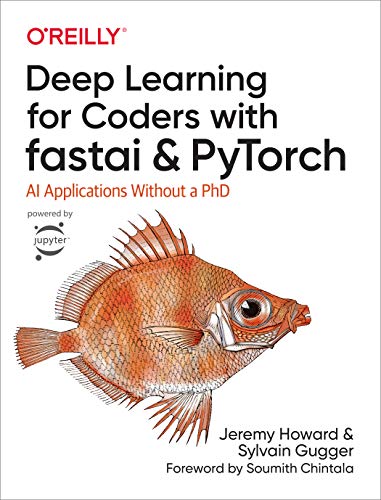
Deep Learning for Coders with Fastai and PyTorch by Jeremy Howard is a practical guide that teaches you how to build and train deep learning models using the fastai library and PyTorch. It focuses on hands-on coding and real-world applications, making deep learning accessible to beginners.
Topics
Table of Contents
- Deep Learning for Coders with Fastai and PyTorch: summary of key ideas
- What is Deep Learning for Coders with Fastai and PyTorch about?
- Deep Learning for Coders with Fastai and PyTorch Review
- Who should read Deep Learning for Coders with Fastai and PyTorch?
- About the author
- Book summaries like Deep Learning for Coders with Fastai and PyTorch
- People also liked these summaries
- Deep Learning for Coders with Fastai and PyTorch FAQs
Deep Learning for Coders with Fastai and PyTorch
Summary of key ideas
Understanding Deep Learning with Fastai and PyTorch
In Deep Learning for Coders with Fastai and PyTorch by Jeremy Howard, we are introduced to the world of deep learning from a practical, hands-on perspective. The book begins with an overview of the fastai library, which is built on top of PyTorch, a popular open-source deep learning framework. The author's approach is to make deep learning accessible to coders of all levels, and to emphasize that understanding the concepts and algorithms is more important than mastering the mathematics behind them.
Howard begins by guiding us through the process of training a deep learning model, using a simple image recognition task as an example. He explains the key concepts such as loss functions, optimizers, and learning rates, and demonstrates how to use fastai to train a state-of-the-art model with just a few lines of code. The book then progresses to more advanced topics, including transfer learning, data augmentation, and handling large datasets efficiently.
Exploring Different Deep Learning Applications
As we move deeper into the book, we explore other applications of deep learning, such as natural language processing (NLP) and tabular data analysis. Howard shows us how to use fastai to build and train models for these tasks, and how to interpret the results effectively. He also introduces us to the concept of collaborative filtering, which is commonly used in recommendation systems, and demonstrates how to implement it using deep learning.
In each case, the author emphasizes the importance of understanding the problem domain and the dataset, and how to use this understanding to fine-tune the model's performance. This approach helps to demystify the process of deep learning, making it more approachable and less intimidating for coders who are new to the field.
Understanding the Inner Workings of Deep Learning
Howard then takes a deep dive into the inner workings of deep learning models. He explains the architecture and training process of convolutional neural networks (CNNs) for computer vision tasks, recurrent neural networks (RNNs) for sequential data, and transformer models for NLP tasks. He also introduces us to techniques such as attention mechanisms and gradient clipping, which are crucial for understanding and improving the performance of these models.
Throughout these discussions, the author maintains a practical focus, providing clear explanations and real-world examples. He also shows us how to use fastai to implement these advanced models and techniques, demonstrating that complex deep learning concepts can be made accessible and easy to work with.
Building and Deploying Deep Learning Applications
After gaining a solid understanding of deep learning theory and practice, Howard shifts the focus to applying this knowledge in real-world scenarios. He demonstrates how to turn a trained deep learning model into a web application using the fastai library, allowing users to interact with the model through a simple interface. This practical demonstration illustrates how deep learning can be used to create useful and impactful applications.
Finally, the book concludes with a discussion on the ethical considerations of deep learning. Howard highlights the potential biases and ethical implications of using machine learning models in decision-making processes, and emphasizes the responsibility of developers and researchers to address these issues.
Conclusion: A Practical and Accessible Introduction to Deep Learning
In conclusion, Deep Learning for Coders with Fastai and PyTorch by Jeremy Howard offers a comprehensive and accessible introduction to deep learning. The book demystifies the world of deep learning by focusing on practical applications and providing clear explanations of complex concepts. By emphasizing a hands-on approach and the importance of understanding the problem domain, Howard makes deep learning approachable for coders of all levels, and encourages them to explore this exciting and rapidly evolving field.
More knowledge in less time

Read or listen
Get the key ideas from nonfiction bestsellers in minutes, not hours.

Find your next read
Get book lists curated by experts and personalized recommendations.

Shortcasts
We've teamed up with podcast creators to bring you key insights from podcasts.
What is Deep Learning for Coders with Fastai and PyTorch about?
Deep Learning for Coders with Fastai and PyTorch is a practical book that introduces deep learning concepts in a hands-on manner. Written by Jeremy Howard and Sylvain Gugger, it aims to make deep learning accessible to coders and practitioners without a background in data science or machine learning. The book covers topics such as neural networks, convolutional neural networks, recurrent neural networks, and transfer learning, using the Fastai and PyTorch libraries.
Deep Learning for Coders with Fastai and PyTorch Review
- Delving into practical applications of deep learning, it equips readers with the tools to solve real-world problems efficiently.
- By providing step-by-step guidance and hands-on exercises, the book ensures a clear understanding of complex concepts.
- Its engaging approach to teaching through examples and insights keeps readers absorbed, making the learning experience far from dull.
Who should read Deep Learning for Coders with Fastai and PyTorch?
Aspiring data scientists and machine learning engineers who want to learn practical deep learning techniques
Software developers and programmers looking to incorporate deep learning into their projects
Professionals seeking to expand their knowledge and skill set in the rapidly evolving field of artificial intelligence
Categories with Deep Learning for Coders with Fastai and PyTorch
Book summaries like Deep Learning for Coders with Fastai and PyTorch
 Big DataMayer-Schonberger, CukierA Revolution That Will Transform How We Live, Work and Think4.3
 On intelligence Jeff Hawkins, Sandra BlakesleeHow a New Understanding of the Brain Will Lead to the Creation of Truly Intelligent Machines3.9
 The Signal and the NoiseNate SilverWhy So Many Predictions Fail — but Some Don't4.2
 You Are Not a GadgetJaron LanierA Manifesto3.9
 The Future of the MindMichio KakuThe Scientific Quest to Understand, Enhance, and Empower the Mind4.4
 Too Big to IgnorePhil SimonThe Business Case for Big Data4.1
 The Intel TrinityMichael S. MaloneHow Robert Noyce, Gordon Moore and Andy Grove Built the World’s Most Important Company4.2
 BreakpointJeff StibelWhy the Web will Implode, Search will be Obsolete, and Everything Else you Need to Know about Technology is in Your Brain4.0
 Information Doesn’t Want to Be FreeCory DoctorowLaws for the Internet Age3.6
 The Master AlgorithmPedro DomingosHow The Quest For The Ultimate Learning Machine Will Remake Our World4.4
 The InevitableKevin KellyUnderstanding the 12 Technological Forces That Will Shape Our Future4.2
 StretchKarie Willyerd and Barbara MistickHow to Future-Proof Yourself for Tomorrow’s Workplace3.8
 The Filter BubbleEli PariserWhat the Internet is Hiding From You4.0
 IrresistibleAdam AlterThe Rise of Addictive Technology and the Business of Keeping Us Hooked4.2
 The Innovator’s HypothesisMichael SchrageHow Cheap Experiments Are Worth More than Good Ideas3.8
People ❤️ Blinkist
Become a member of our community of 44 million people

96k ratings

73k ratings
Thi Viet Quynh N.
Great app. Good selection of book summaries you can read or listen to while commuting. Instead of scrolling through your social media news feed, this is a much better way to spend your spare time in my opinion.
Sven O.
It's highly addictive to get core insights on personally relevant topics without repetition or triviality. Added to that the apps ability to suggest kindred interests opens up a foundation of knowledge.
Renee D.
I'm absolutely thrilled that Blinkist now offers infographics! I can't get enough of them—they're such a fun and effective way to grasp and remember key points.
People also liked these summaries
 Age of DiscoveryIan Goldin (Author), Chris KutarnaNavigating the Risks and Rewards of Our New Renaissance 4.3
 Sensemakingby Christian MadsbjergWhat Makes Human Intelligence Essential in the Age of the Algorithm4.0
 UX StrategyJaime LevyHow to Devise Innovative Digital Products That People Want 4.1
 Weapons of Math DestructionCathy O'NeilHow Big Data Increases Inequality and Threatens Democracy4.1
 VaporizedRobert TercekSolid Strategies For Success in a Dematerialized World4.4
 The Dark NetJamie BartlettInside the Digital Underworld3.1
 Changing the SubjectSven BirkertsArt and Attention in the Internet Age4.1
 Streaming, Sharing, StealingMichael D. Smith and Rahul TelangBig Data and the Future of Entertainment3.5
 The Distracted MindAdam Gazzaley, Larry D. RosenAncient Brains in a High-Tech World4.1
 Life 3.0Max TegmarkBeing Human in the Age of Artificial Intelligence 4.3
 The Age of Spiritual MachinesRay KurzweilWhen Computers Exceed Human Intelligence4.3
 Bad BloodJohn CarreyrouSecrets and Lies in a Silicon Valley Startup4.2
 The One DeviceBrian MerchantThe Secret History of the iPhone3.6
 BuiltRoma AgrawalThe Hidden Stories Behind our Structures4.6
 Ghost in the WiresKevin D. Mitnick, William L. Simon, Steve WozniakMy Adventures as the World's Most Wanted Hacker4.5
Trusted by the world's leading brands

Powerful ideas from top nonfiction
Try Blinkist to get the key ideas from 7,500+ bestselling nonfiction titles and podcasts. Listen or read in just 15 minutes.
Get started
Blink 3 of 8 - The 5 AM Club
by Robin Sharma
Deep Learning for Coders with Fastai and PyTorch FAQs
What is the main message of Deep Learning for Coders with Fastai and PyTorch?
How long does it take to read Deep Learning for Coders with Fastai and PyTorch?
Is Deep Learning for Coders with Fastai and PyTorch a good book? Is it worth reading?
Who is the author of Deep Learning for Coders with Fastai and PyTorch?
Featured Titles
- Actionable Agile Metrics for Predictability
- Advances in Financial Machine Learning
- Agile Project Management with Kanban
- Agile Software Requirements
- Angela's Ashes
- CISSP All-in-One Exam Guide
- Click Here to Kill Everybody
- Comptia Network+ Certification
- Generative Deep Learning
- Hands-On Machine Learning with Scikit-Learn and TensorFlow