


Powerful ideas from top nonfiction
Try Blinkist to get the key ideas from 7,500+ bestselling nonfiction titles and podcasts. Listen or read in just 15 minutes.
Get started for free
Blink 3 of 8 - The 5 AM Club
by Robin Sharma
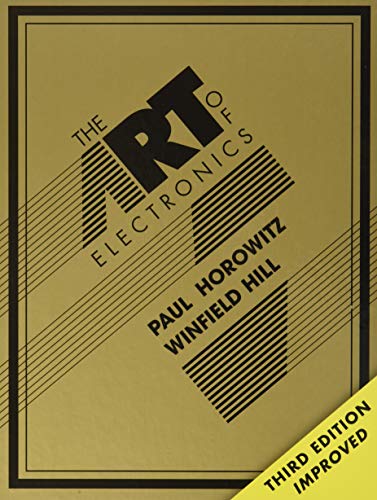
The Art of Electronics by Paul Horowitz is a comprehensive guide to electronic circuits and design. It covers everything from basic principles to advanced topics, making it a valuable resource for both beginners and experienced engineers.
In The Art of Electronics by Paul Horowitz and Winfield Hill, we embark on a comprehensive journey to understand the fundamentals of electronics. The book begins with an exploration of the basics of electronic components such as resistors, capacitors, inductors, diodes, transistors, and operational amplifiers. Each component is explained in detail, including its behavior in circuits and its applications.
Horowitz and Hill then delve into the concept of voltage, current, and resistance, and introduce key electrical laws such as Ohm's Law and Kirchhoff's Laws. They provide a thorough explanation of semiconductor physics, including the behavior of electrons in a semiconductor material, the p-n junction, and the operation of diodes and transistors.
As we progress through The Art of Electronics, we learn about the principles of circuit analysis and design. The authors introduce us to the concept of equivalent circuits and show us how to simplify complex circuits for easier analysis. They also discuss different circuit configurations and their applications, including voltage dividers, current sources, and amplifiers.
Horowitz and Hill then guide us through different methods of analyzing circuits, such as nodal and mesh analysis, Thevenin and Norton equivalents, and the use of Laplace transforms. They also provide an in-depth discussion of frequency response and introduce us to the concept of filters, amplifiers, and oscillators.
One of the highlights of The Art of Electronics is the extensive coverage of operational amplifiers (op-amps). The authors explain the ideal op-amp model, its applications in amplifiers, filters, and other circuits, and the various op-amp configurations. They also introduce us to the concept of negative feedback and its significance in op-amp circuits.
After thoroughly covering analog electronics, the book transitions into digital electronics. We learn about digital logic gates, flip-flops, and registers, and we are introduced to the concept of sequential and combinational logic circuits. The authors also discuss the basics of microcontrollers and digital signal processing.
In the latter part of the book, Horowitz and Hill focus on the practical aspects of electronics. They discuss the selection and use of electronic components, the construction of electronic circuits on prototyping boards or printed circuit boards, and the importance of proper grounding and shielding techniques.
The authors also emphasize the significance of testing and troubleshooting electronic circuits. They provide valuable tips for identifying and rectifying common circuit faults, and they discuss the use of test equipment such as oscilloscopes, multimeters, and signal generators.
As we near the end of the book, Horowitz and Hill introduce us to some advanced topics in electronics. They cover topics such as feedback amplifiers, power supplies, and precision measurement techniques. Additionally, they discuss the principles of radio-frequency (RF) electronics and the basics of communication systems.
In conclusion, The Art of Electronics is a comprehensive guide to understanding the principles and applications of electronics. It provides both theoretical knowledge and practical insights, making it an indispensable resource for students, hobbyists, and professionals in the field of electronics.


The Art of Electronics by Paul Horowitz and Winfield Hill is a comprehensive book that covers the fundamental principles and practical aspects of electronic circuits and devices. It is widely regarded as a must-read for anyone interested in the field, whether you're a beginner or an experienced engineer. The book is filled with clear explanations, insightful examples, and valuable tips, making it an invaluable resource for learning and reference.
Electronics enthusiasts who want to deepen their understanding of the subject
Students studying electrical engineering or related fields
Professionals in the electronics industry looking to expand their knowledge and skills
It's highly addictive to get core insights on personally relevant topics without repetition or triviality. Added to that the apps ability to suggest kindred interests opens up a foundation of knowledge.
Great app. Good selection of book summaries you can read or listen to while commuting. Instead of scrolling through your social media news feed, this is a much better way to spend your spare time in my opinion.
Life changing. The concept of being able to grasp a book's main point in such a short time truly opens multiple opportunities to grow every area of your life at a faster rate.
Great app. Addicting. Perfect for wait times, morning coffee, evening before bed. Extremely well written, thorough, easy to use.
Try Blinkist to get the key ideas from 7,500+ bestselling nonfiction titles and podcasts. Listen or read in just 15 minutes.
Get started for freeBlink 3 of 8 - The 5 AM Club
by Robin Sharma